Automated Blade Grinding and Robotic Polishing: Inside a Modern Kitchen Knife Line
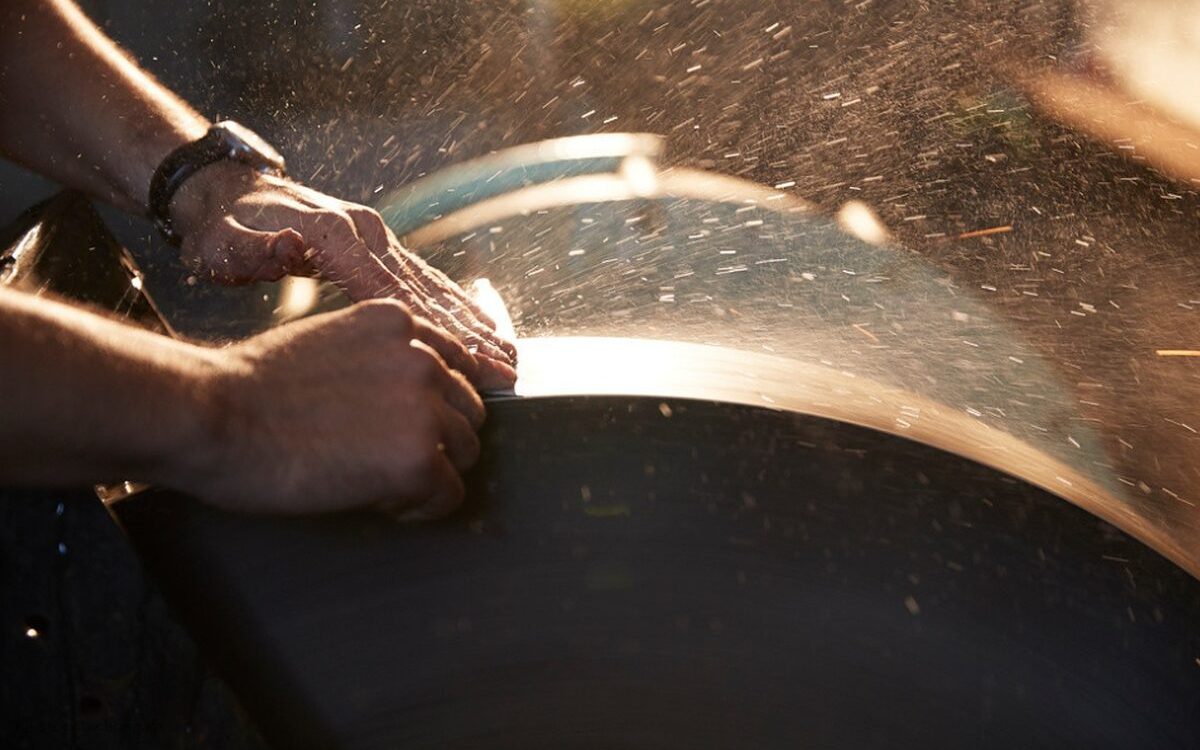
Twenty years ago, blade grinding in a cutlery factory was a room full of people bent over water-cooled wheels, feeling the bevel by hand. Today a modern line runs CNC grinding cells, robot polishing arms and vision inspection, with a small number of skilled people setting up and auditing the process rather than performing every pass.
This is what actually changes when a knife line is automated — and what does not.
The stages of making a blade
- Blanking. The blade profile is cut from steel strip on a press, laser or waterjet. Blanking yield — how much of the strip becomes blade versus scrap — is a direct cost driver.
- Forging (optional). Hot drop forging in a die forms the blade, bolster and tang as one piece with continuous grain flow, instead of cutting the shape out of flat stock.
- Normalising and annealing. Relieves the stress introduced by blanking and forging so the blade does not distort during hardening.
- Hardening. Austenitise, quench, then temper. This is the single most important step for how the knife performs, and the one buyers inspect least.
- Grinding and bevel setting. Sets the primary bevel, the edge thickness and the final cutting geometry.
- Polishing and finishing. Satin, mirror or brushed, plus any surface treatment.
- Handle fitting and riveting.
- Sharpening and inspection. Final edge, then hardness or edge checks before packing.
What CNC grinding changed
| Manual grinding | CNC grinding | |
|---|---|---|
| Bevel angle consistency | Depends on the operator's feel; varies knife to knife | Held to the programmed angle within machine tolerance across the run |
| Ability to reproduce a profile | Difficult — the same "10 inch chef" comes out slightly different between batches | Exact — the program is the specification |
| Cost at low volume | Lower | Higher, because programming and setup are spread over fewer pieces |
| Cost at high volume | Higher, and rising with wage inflation | Lower per piece |
| Best at | Complex asymmetric grinds, hand-finished thin edges | High-volume consistent geometry |
The practical consequence for buyers is that CNC grinding makes the bevel angle a specification you can hold the supplier to, rather than an aspiration. If you ask for 15° per side and the supplier grinds on a CNC cell, you should be able to get measurements, not assurances.
Robotic polishing: consistency where it was hardest
Polishing is dusty, repetitive and easy to do badly. A blade polished by hand can carry uneven scratch direction, rounded edges where the surface should be crisp, and heat marking if the piece is held too long. Robot arms with force control hold the same pressure and path across every blade.
What this really buys is visual uniformity, which matters more than it sounds. In a retail set of six knives sitting in a block, a single blade whose finish does not match the other five is a customer complaint waiting to happen. Automated polishing is largely a set-quality investment.
Vision inspection and the move to measurable quality
Camera inspection stations can check profile against the CAD outline, detect grinding marks left in the wrong zone, measure edge thickness at defined points, and read the laser mark for legibility and position. The important shift is philosophical: quality becomes a set of numbers logged per batch instead of a foreman's opinion.
For a buyer, that is leverage. Ask what is measured in-line, at what sampling frequency, and whether the records are kept. A supplier who cannot answer has a quality system that exists only in the certificate.
Heat treatment: the part automation helps least, and matters most
Hardening is a time-and-temperature problem. A continuous mesh-belt furnace gives every blade the same austenitising time and quench entry, which is a genuine consistency advantage over loading batches by hand. Modern lines also log furnace temperature curves per batch.
But the steel grade still sets the ceiling, and the tempering cycle still decides the final balance between hardness and toughness. This is why reading an HRC report properly tells you more about a factory than the equipment list does. A line with a good furnace and a sloppy hardness spec will still ship blades that chip.
What automation does not fix
- Wrong specification. If the buyer asked for a thin 20 HRC per side bevel and the factory programmed 20° inclusive, the machine will execute the error with beautiful consistency.
- Substituted steel. A parallel importer can still feed a lower grade into an excellent grinder.
- Handle fit. Assembly is where automation still lags; gaps, proud rivets and off-centre scales are assembly defects, not machine defects.
- The final edge on premium product. For the top tier, a short hand-finishing pass after the machine is standard practice in every serious factory, in every region.
What to ask when you audit a line
| Question | Good answer looks like |
|---|---|
| How is hardness verified? | Rockwell tester on site, multiple points per blade, records retained per batch |
| Who grinds the bevel? | CNC cells with programs per model; angle and edge thickness recorded |
| What is inspected in-line? | Profile, edge thickness, logo position, finish uniformity — with stated sampling |
| How is furnace data kept? | Per-batch temperature logs, traceable to the order |
| What is still manual? | An honest answer — assembly and final edge touch-up, with the QA gate that follows |
Our manufacturing process page documents how these stages run in our supply chain, and our factory audit checklist covers the wider questions.
FAQ
Does automation make knives cheaper?
At high volume, yes, mainly by reducing labour per piece and scrap rate. At low volume it can be more expensive, because programming and setup dominate. That is one reason MOQ exists.
Can I tell whether a knife was CNC ground?
Not by looking at one piece. Look at a group: automated grinding shows an even, repeating bevel with very little variation. Manual grinding shows character — sometimes beautiful, sometimes inconsistent. A set of six identical feels is the tell.
Is hand-made better?
Different, not better. Hand grinding wins where the grind is complex or the edge must be taken unusually thin. Machine grinding wins on repeatability and cost. The best premium knives use both.
Looking for a kitchen knife manufacturer?
We manufacture chef knives, knife sets, Damascus and steak knives in Yangjiang with OEM and private label service. Get a quote today.
Get Free Quote → Browse Products