EU, US and Japan Kitchen Knife Compliance: A 2026 Export Guide for Buyers
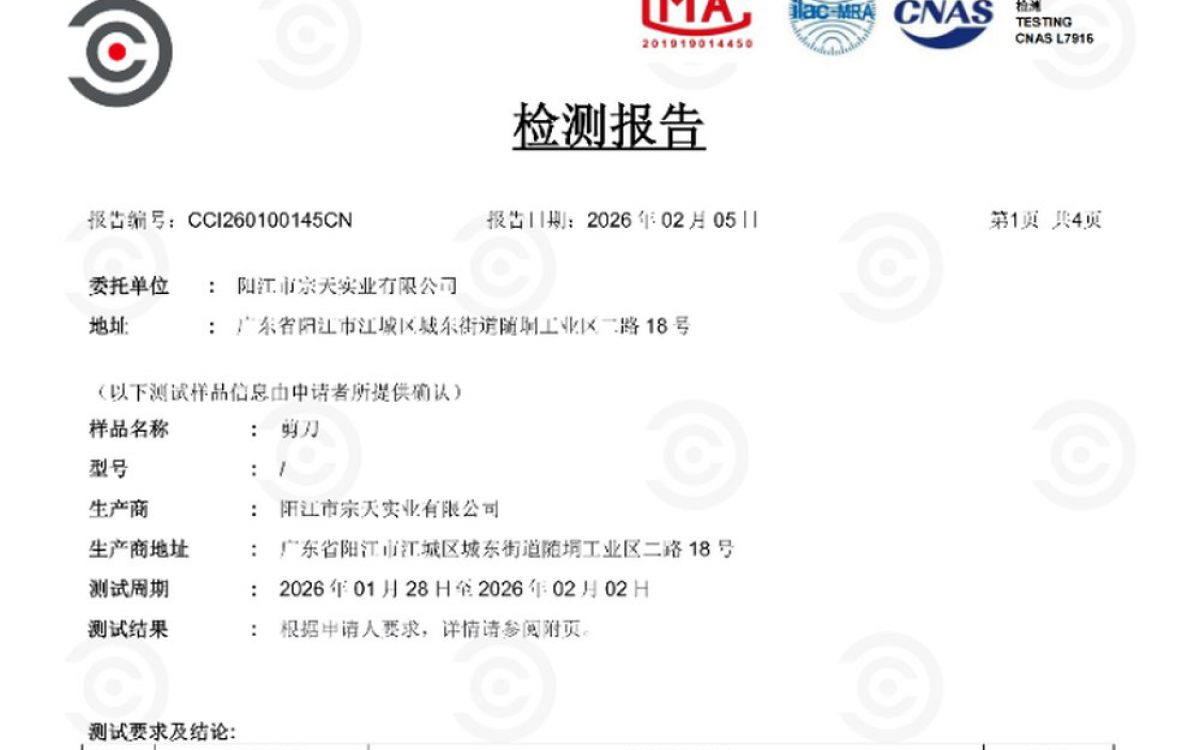
A chef knife is a piece of cutlery. But the moment it is sold into a kitchen, it also becomes a food contact material — and that second identity is regulated separately in every major market. A blade that is perfectly legal to import as hardware can be stopped at customs, recalled from retail, or fined if the food contact documentation is wrong.
This guide walks through the three regimes that matter most for kitchen knife exports — the European Union, the United States and Japan — and points out where importers most often get caught.
Why knives are regulated as food contact materials
Food contact regulation exists because a blade, a handle and a rivet sit in contact with food for minutes at a time, at temperatures from freezing to 200 °C, in the presence of salt, acid and fat. Those conditions can pull metal ions and polymer additives out of a material and into food.
Three things are regulated in practice:
- Composition — what the material is allowed to contain (e.g. lead and cadmium limits in steel, monomer limits in plastics).
- Migration — how much of a substance actually transfers into food or a food simulant under defined test conditions.
- Declaration — the paperwork that lets the next party in the chain prove compliance without re-testing.
European Union: framework, GMP and sector-specific rules
The EU does not issue a single "knife certificate". Compliance is built from layers:
| Layer | Instrument | What it covers |
|---|---|---|
| Framework | Regulation (EC) No 1935/2004 | General safety: materials must not transfer constituents in quantities that endanger health or change food composition. Also requires documentation and traceability. |
| Good manufacturing practice | Regulation (EC) No 2023/2006 | Quality assurance and documentation systems at the manufacturing stage. |
| Plastics (handles, coatings) | Regulation (EU) No 10/2011 | Authorised monomers and additives, overall and specific migration limits, declaration of compliance. |
| Metals and alloys | Council of Europe Resolution CM/Res(2013)9 and the EDQM technical guide | Release limits for nickel, chromium, manganese, iron, copper, zinc, aluminium and others, tested in food simulants. |
| National reference (Germany) | LFGB §30 and §31, plus BfR Recommendations | The de facto benchmark many EU buyers quote. §30 covers health protection, §31 covers misleading claims. |
What the metals limits look like in practice
The Council of Europe resolution sets release limits per element in food simulant — nickel, chromium and manganese are the ones that trip up cutlery most often, because cutlery steel is chromium-rich by design. Typical cited limits are in the region of 0.14 mg/kg for nickel, 0.25 mg/kg for chromium and 1.8 mg/kg for manganese, measured per the standard migration protocol.
Always confirm the numbers against the current edition of the EDQM technical guide and your destination member state's national rules. Member states layer their own requirements on top of the resolution, and the values have been revised before.
The declaration of compliance
For EU buyers, the working document is the Declaration of Compliance (DoC). It should name the material, the regulation it is declared against, the migration test conditions, the testing laboratory, and the identity of the responsible business in the EU. A DoC issued by a trading company that cannot point to a factory is worth very little — see our 15-point factory audit checklist for how to test that claim.
United States: no "food grade steel" list, but plenty of exposure
The US system is different in character. There is no pre-market approval for a knife as a finished article, and no single FDA certificate for stainless steel cutlery. Instead:
- 21 CFR Parts 174–178 govern indirect food additives — substances that may reasonably become components of food through contact. Stainless steel is generally treated under the general safety provisions, with the burden of proof on the supplier that it does not impart harmful substances.
- 21 CFR 177.2600 applies when a handle or grip is rubber or elastomer based, and sets extractable limits depending on the intended food type and temperature.
- 21 CFR 175.300 / 177.1210 matter if the knife carries a resin coating or a sealing gasket in the handle.
- California Proposition 65 is the practical sticking point. It requires a clear warning for listed substances above defined exposure levels — for cutlery, the relevant ones are usually lead and cadmium in the alloy or in decoration and coatings. Because Prop 65 allows private enforcement, it drives more product recalls and claims than the FDA rules themselves.
In practice, a US-bound order is usually supported by: material composition reports, migration or leachable test results from an accredited lab, and where needed, a Prop 65 assessment. If a supplier offers a document simply called "FDA certificate", treat it with caution — ask what test, what standard and what laboratory.
Japan: the positive list transition is the live issue
Japan regulates vessels and packaging under the Food Sanitation Act, with specifications set out in Ministry of Health, Labour and Welfare Notification No. 370 of 1959. Metal utensils have defined limits on lead, cadmium and other elements. In 2020 the Act was amended to introduce a positive list system for synthetic resins — only listed raw materials may be used, and a full transition period ended in June 2025.
That matters for knives because the handle, not the blade, is usually the regulated part. A handle made from a resin that is not on the positive list, or for which the migration test data cannot be produced, is a compliance problem regardless of how good the steel is.
Where buyers actually get caught
| Failure | Typical cause | How to prevent it |
|---|---|---|
| Blade leaches nickel above limit | Low-grade alloy with an uncontrolled melt, or surface contamination from polishing compounds | Specify the steel grade in writing, request release testing on the finished article, not the raw coil |
| Handle fails plastic rules | Subcontractor changes resin supplier mid-order without telling anyone | Freeze the material specification and require written approval for any substitution |
| Prop 65 without warning | Decorative coating or brass rivets containing lead | Test rivets and coatings separately — they are not the same alloy as the blade |
| Documentation that cannot be traced | DoC issued by a trader, no factory name, no test report numbers | Require the DoC to reference specific report numbers and the producing factory |
| Japan PL non-compliance | Handle resin not listed, or no migration data available | Confirm resin identity and positive list status before tooling is cut |
A practical compliance pack to ask for
- Material composition statement naming the exact steel grade and the handle material.
- Migration / release test report from an accredited third-party laboratory, on the finished knife.
- Declaration of Compliance referencing the specific regulation and test conditions.
- For Japan: positive list conformity statement for the resin, where a resin handle is used.
- For the US: leachable metals data and, where applicable, a Prop 65 assessment.
- Factory quality system evidence — see our manufacturing process page for the stages that should be documented.
Because these documents are generated per material and per market, the cheapest time to sort them out is before the order, not after the container leaves the port. If you are planning a first order, our OEM and ODM page describes how we handle specification, sampling and documentation together.
FAQ
Does a knife need an FDA certificate to be sold in the US?
No. There is no FDA certificate for a stainless steel knife as such. What matters is that the food contact materials meet the applicable indirect food additive rules and that the supplier can document composition and leachables testing.
Is LFGB mandatory in the EU?
LFGB is German national law. It is not directly binding across the EU, but it is widely used as a contractual benchmark because it is well defined and accepted by European retailers. The underlying EU obligation comes from Regulation (EC) No 1935/2004 and the sector-specific acts.
Can one test report cover all markets?
Rarely. The food simulants, exposure temperatures and duration differ between the EU and Japanese protocols, and US requirements are structured differently again. Expect separate testing per destination.
Looking for a kitchen knife manufacturer?
We manufacture chef knives, knife sets, Damascus and steak knives in Yangjiang with OEM and private label service. Get a quote today.
Get Free Quote → Browse Products