Yangjiang, Solingen and Seki: How the World's Kitchen Knife Manufacturing Belts Differ
Almost every kitchen knife in the world comes from one of three places. Not because other countries cannot make knives, but because three regions built up the full stack — steel supply, forging and grinding skill, heat treatment, handle work, finishing and packaging — close enough together that a complete knife can be made within a few kilometres.
Understanding how Yangjiang, Solingen and Seki differ is the fastest way for a buyer to know which one fits an order.
The three belts at a glance
| Yangjiang, Guangdong (China) | Solingen, Germany | Seki, Gifu (Japan) | |
|---|---|---|---|
| Reputation | Volume and full-range OEM | Engineering, forged quality | Edge sharpness, artisan craft |
| Typical steel | 3Cr13 to 1.4116 / 5Cr15MoV, VG-10 class, Damascus billet | X50CrMoV15, 1.4116, specialty German and Swedish grades | VG-10, SG2/R2 class, White and Blue paper carbon steels |
| Process bias | Stamping plus forging lines, very high automation | Hot-drop forging, robot-assisted grinding | Hand grinding by specialist sharpeners |
| Painful point | Quality spread between suppliers is wide | Cost and minimum order size | Capacity, lead time, price escalation |
| Best fit | Private label programmes, retail sets, cost-targeted lines | Premium housewares brands, "made in Germany" claims | High-end chef brands, small prestige runs |
Yangjiang: the volume engine
Yangjiang has the deepest supplier base of the three. Its advantage is not one factory but the ecosystem: blade blanking houses, grinding shops, heat treatment lines, handle moulders, laser marking shops and packaging printers all operating within a short drive of each other.
That density is why Yangjiang can support small runs of a custom shape at a price no European workshop can touch. A buyer can have a new pattern blanked, hardened, ground, assembled, marked and boxed using different specialist vendors, coordinated by one exporter.
What to watch. Capability varies enormously between factories. Two suppliers quoting the same specification can differ by ten points of HRC consistency, by whether hardness is checked dimensionally across the blade, and by whether the steel grade on the invoice is the steel grade in the melt. This is why a factory audit matters more here than anywhere else — our supplier audit checklist covers the specific tests to ask for. It is also why specifying an exact steel grade rather than "high carbon stainless" changes the outcome.
Solingen: forged quality and the rules around the name
Solingen's identity is hot-drop forging: a billet is heated and struck in a die so the blade, bolster and tang are formed from one piece of steel, with the grain flow following the shape of the blade. That is the structural reason a forged blade usually feels different from a stamped one.
Solingen is also a protected geographical indication. "Solingen" on a knife is not a style description — it is a designation with rules about where the essential manufacturing steps must take place. Buyers who want to use the origin in marketing need to understand that boundary, and should treat any offer of "Solingen-style" product from another region as a separate product, not an equivalent one.
What to watch. Order sizes are typically larger and the tooling investment higher, which makes Solingen a poor fit for a test-the-market run. Lead times also run longer than in Asia.
Seki: the sharpest edge, in the smallest volumes
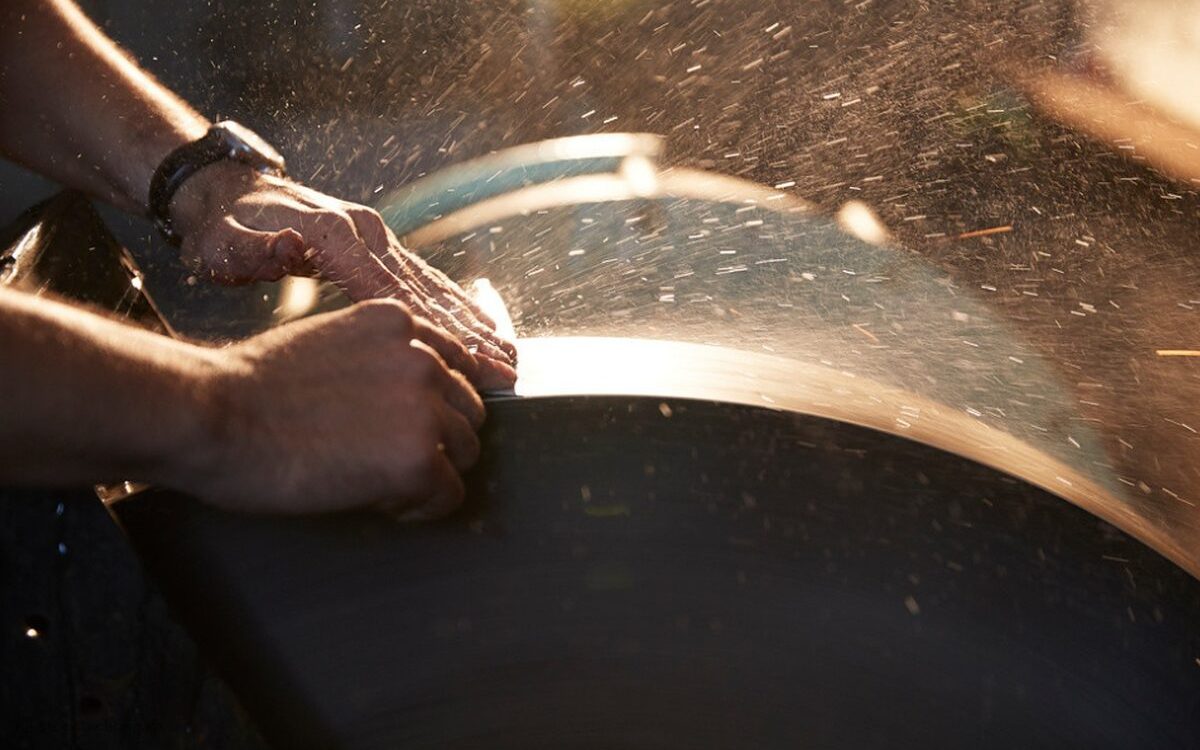
Seki's strength is edge geometry. The region's sharpeners work by hand with water-cooled wheels and control the bevel angle and edge thinning to a degree that is hard to replicate on a fully automated line. That is why Seki knives are judged on cutting feel rather than on a hardness number alone.
The trade-off is capacity. Hand grinding is a bottleneck that cannot be scaled by adding shifts, so lead times stretch and prices are the highest of the three. Seki also runs strong internal quality traditions — a mediocre Seki knife is unusual, but a cheap one is rarer still.
What to watch. Cultural and language distance makes specification errors more expensive to correct, and small pilot orders are often declined. Buyers typically move to Seki after a premium line has proven itself, not before.
Turkey, Vietnam, India and others
It is worth noting that other regions are real competitors in specific niches: Turkey in stamped housewares and forged lines for Europe, Vietnam in low-cost stamped product, India in some stainless flatware-adjacent categories, Brazil and Mexico for the Americas. They usually compete on landed cost and proximity rather than on the full range of steel and finishing options.
How to choose, by order profile
| If your situation is… | Consider | Because |
|---|---|---|
| First private label order, testing the market | Yangjiang | Low tooling and low MOQ make an initial run affordable; the range of handle materials and packaging is the widest |
| Retail set programme, fixed target price | Yangjiang | Set assembly, block sourcing and gift packaging can all be handled inside one supply chain |
| Premium brand needing forged construction | Solingen or a Yangjiang factory with its own forging line | Forged grain flow and bolster integration; ask for proof the forging is in-house, not outsourced |
| Chef-endorsed flagship blade, low volume, high price | Seki | Edge geometry that survives expert scrutiny |
| Multi-market programme with different compliance needs | Yangjiang with documentation support | Easier to run multiple destination-specific packs from one factory — see our compliance guide |
Why buyers mix sources rather than pick one
Mature programmes rarely use a single origin. A common structure is: an Asian factory for the volume entry-level line, the same or a second Asian factory for a forged mid-tier line, and a European or Japanese partner for the top of the range that exists mainly to give the brand credibility. The top line may not be the most profitable unit — its job is to make the middle line credible at its price.
FAQ
Is Japanese steel better than Chinese steel?
The steel itself is the same family of alloys when the grade matches. What differs is process control — consistency of heat treatment, accuracy of grinding and the sharpener's skill. A 1.4116 blade with a well-controlled 56 ±1 HRC and a thin, even bevel will out-cut a poorly hardened expensive grade.
Can a Yangjiang factory genuinely forge?
Yes, and a number of them do, with their own drop hammers or press forging lines. Ask to see the forging equipment during an audit, and ask whether bolster integration is forged or welded. Forged bolsters welded onto a stamped blade are a common cost-saving hybrid.
How much does origin affect price?
For the same specification, the spread between an efficient Asian line and a European workshop is typically a multiple rather than a percentage. That is why "made in Germany" or "made in Japan" is normally reserved for a brand's top tier.
Looking for a kitchen knife manufacturer?
We manufacture chef knives, knife sets, Damascus and steak knives in Yangjiang with OEM and private label service. Get a quote today.
Get Free Quote → Browse Products