Kitchen Knife Steel Grades Explained: 3Cr13, 5Cr15MoV, 1.4116, VG-10, 14C28N and Damascus
Ask three suppliers what steel a knife uses and you may get three different answers for the same physical material: "5Cr15MoV", "1.4116", "X50CrMoV15", "German steel", "high carbon stainless". They refer to overlapping things — a Chinese GB grade, a German DIN number, a European short name and a marketing phrase.
This guide maps the grades that actually appear on kitchen knife specifications, with indicative compositions and achievable hardness.
First, the naming systems
| System | Example | How to read it |
|---|---|---|
| Chinese GB | 5Cr15MoV | Digits before the first element are carbon in hundredths of a percent: ~0.5% C. Then Cr 15%, Mo, V. |
| German DIN / EN | 1.4116, X50CrMoV15 | The material number is 1.4116. The short name reads the same way: X = high alloy, 50 = 0.50% C, CrMoV15 = alloying elements. |
| AISI / SAE | 440C, 420J2 | A number series, not a composition code. You have to know the grade. |
| Japanese trade names | VG-10, AUS-8, 14C28N | Proprietary designations from specific mills. Composition is published by the mill. |
| Marketing | "German steel", "surgical steel", "high carbon stainless" | No defined composition. Useful only as a hint that a real grade was probably used. |
Note that 5Cr15MoV and 1.4116 / X50CrMoV15 are close relatives, not identical specifications — the composition windows overlap but are not the same document. If your buyer's specification names one, ask the factory to confirm which document they are working to.
Composition and hardness, by grade
Figures below are indicative typical values for the grade as used in cutlery. Always verify against the mill certificate for the actual melt.
| Grade | C | Cr | Other | Achievable HRC | Character |
|---|---|---|---|---|---|
| AISI 420J2 | 0.15–0.25 | 12–14 | — | ~50–54 | Very corrosion resistant, low hardness. Entry-level and decorative use. |
| 3Cr13 | 0.26–0.35 | 12–14 | — | ~48–53 | Cheap, tough, poor edge retention. Common on budget kitchen knives. |
| 1.4116 / X50CrMoV15 | 0.45–0.55 | 14–15 | Mo 0.5–0.8, V 0.1–0.2 | ~54–57 | The European kitchen standard. Balanced, forgiving, easy to sharpen, good corrosion resistance. |
| 5Cr15MoV | 0.45–0.55 | 14–15 | Mo 0.5–0.8, V 0.1–0.2 | ~55–58 | The Chinese workhorse. Similar role to 1.4116, quality varies with the mill. |
| 8Cr14MoV / 8Cr13MoV | 0.70–0.80 | 13–14.5 | Mo 0.1–0.3, V 0.1–0.25 | ~56–58 | AUS-8 class. Better edge retention than 5Cr, slightly less corrosion resistance. |
| AUS-8 | 0.70–0.75 | 13–14.5 | Mo 0.1–0.3, V 0.1–0.26, Ni 0.49 | ~57–59 | Japanese mid-tier. Nice balance; a common choice for mid-range Japanese-style knives. |
| AISI 440C | 0.95–1.20 | 16–18 | Mo 0.75 | ~57–59 | Very corrosion resistant for its hardness; can be chippy if taken too hard on a thin edge. |
| 14C28N | ~0.62 | ~14.0 | N 0.11, Si 0.3, Mn 0.6 | ~58–60 | Nitrogen-alloyed. Unusually good toughness at high hardness, very corrosion resistant. Excellent for thin edges. |
| VG-10 | ~1.0 | ~15 | Mo ~1.0, V ~0.2, Co ~1.5 | ~59–61 | The classic high-end Japanese stainless. High edge retention; less forgiving than 1.4116. |
| D2 / Cr12MoV | ~1.5 | ~12 | Mo 1, V 1.1 | ~60–62 | Extreme wear resistance. Because much of the chromium is locked in carbides, corrosion resistance is lower than the 12% Cr suggests. |
| White / Blue paper carbon steel | 1.0–1.3 | low | W or Cr-W | ~60–64 | Japanese artisan carbon steels. Outstanding edge, rusts if not dried. Not for a mainstream retail line. |
HRC figures are the range a well-run heat treatment can reach on a kitchen blade for that grade. Values outside these ranges are possible but usually mean a compromise elsewhere — a 3Cr13 at 58 HRC or an X50CrMoV15 at 63 HRC should raise questions about the certificate rather than the price.
Reading the trade-offs
| Property | What raises it | What it costs you |
|---|---|---|
| Edge retention (wear resistance) | More carbon, more vanadium, harder matrix, higher HRC | Toughness falls; harder to sharpen; more brittle under impact |
| Toughness | Finer grain, lower HRC, more chromium for less carbide volume | Edge rolls and dulls faster |
| Corrosion resistance | More free chromium in solution, nitrogen additions, finer carbide structure | Usually a trade against hardness |
| Ease of sharpening | Lower hardness, softer carbides | Shorter edge life |
The point that gets missed: these are not independent dials. Choosing a steel is choosing a position in a trade-off space, and the heat treatment decides where in that space the finished knife lands. A 1.4116 blade at a well controlled 56 HRC with a fine grind is a better kitchen tool than a VG-10 blade hardened badly or ground thick.
Choosing a grade for a product
| Product tier | Reasonable grade | Target HRC |
|---|---|---|
| Budget retail, likely dishwasher use | 3Cr13 or 420J2 class, or 5Cr15MoV if the price allows | 52–55 |
| Mainstream private label | 1.4116 / 5Cr15MoV | 54–57 |
| Mid-tier with an edge story | 8Cr14MoV, AUS-8, 14C28N | 56–59 |
| Premium and chef-endorsed stainless | VG-10 class, 14C28N on thin grinds | 59–61 |
| Damascus-look premium | Layer-welded billet around a hard core | Core 59–61, cladding softer |
| Table and steak knives | 4Cr13 or 1.4116 class, with good corrosion resistance prioritised | 52–56 |
If you are specifying a grade into a purchase order, say the grade and the target hardness band, not either one alone. Our guide to reading an HRC report explains how to check the second half of that requirement, and our factory audit checklist covers how to test whether the grade on the invoice is the grade in the blade.
The "Damascus" question
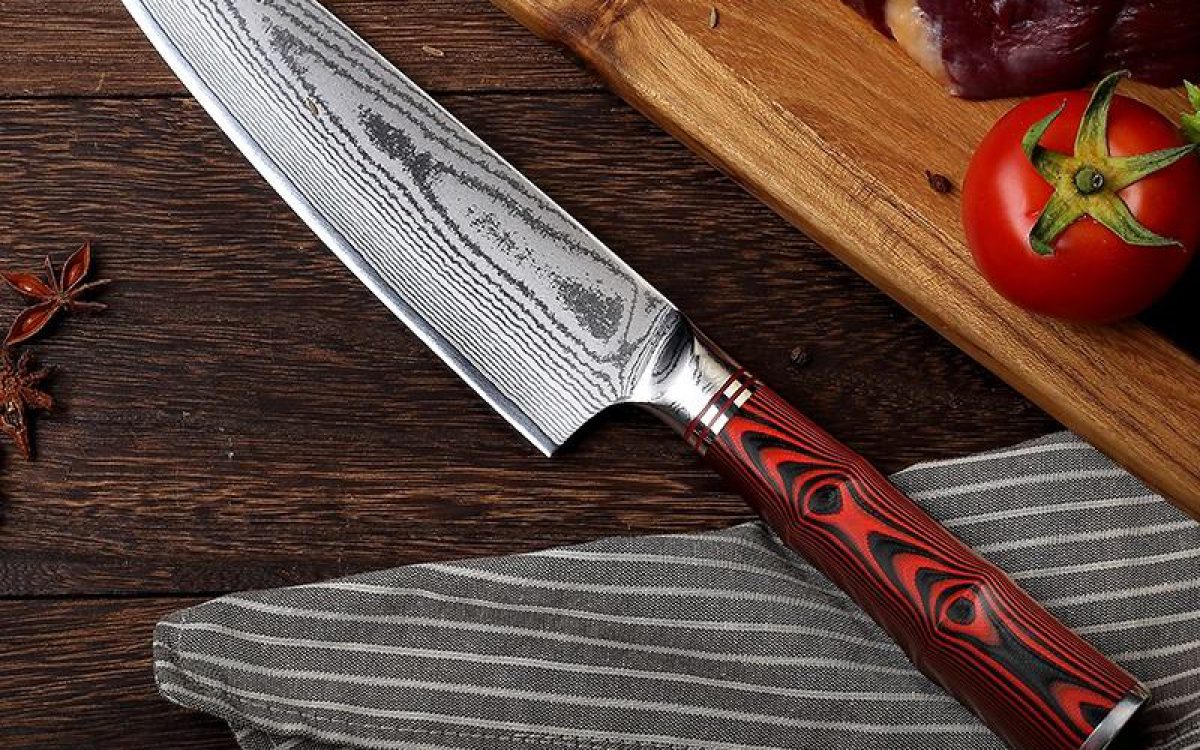
Layer-welded Damascus is not one steel grade but a construction: two or more different steels stacked, forge-welded and folded, then etched to reveal the layer pattern. What matters for performance is the composition of the core, not the pattern. A well-made Damascus blade has a hard core exposed at the edge, clad in softer, more corrosion-resistant layers. See our guide to telling real from decorative Damascus.
FAQ
Is German steel better than Chinese steel?
For an equivalent grade, the alloy is essentially the same. The difference is in mill consistency, heat treatment control and grinding accuracy — all of which are process variables, not geography. A European mill certificate on a Chinese blade is a genuine quality signal. A marketing phrase is not.
What does "surgical steel" mean?
Nothing measurable. It is not a defined cutlery specification. Ask for the grade.
Is a higher carbon content always better?
No. More carbon raises hardenability and potential wear resistance but lowers toughness and often corrosion resistance, and demands tighter process control. On a thin kitchen edge, an unskilled hand with high-carbon steel produces a chipping knife.
Can a factory give me a mill certificate?
It should be able to name the mill and grade and provide the certificate for the coil used. If it cannot, treat the steel claim as unverified — and see our compliance guide for why this matters beyond performance.
Looking for a kitchen knife manufacturer?
We manufacture chef knives, knife sets, Damascus and steak knives in Yangjiang with OEM and private label service. Get a quote today.
Get Free Quote → Browse Products