Food Contact Compliance for Kitchen Knives: EU 1935/2004 and Regulation 10/2011
Every metal kitchen knife sold into the European Union is a food contact material. That single fact generates a set of obligations that sit with the party placing the product on the market, and in private label that party is the brand, not the factory.
This article sets out what EU food contact law requires for a knife, what documentation is actually needed, and where the common failure points are.
The legal framework
| Instrument | What it covers | Effect on a knife |
|---|---|---|
| Framework Regulation (EC) No 1935/2004 | General requirements for all food contact materials | Materials must not transfer constituents in quantities that endanger health, change composition unacceptably, or deteriorate organoleptic properties |
| Good Manufacturing Practice Regulation (EC) No 2023/2006 | GMP for food contact materials | Requires a documented quality assurance system and traceability |
| Regulation (EU) No 10/2011 | Plastic food contact materials | Applies to plastic handles, plastic packaging and any plastic component in the food contact zone |
| Regulation (EC) No 1907/2006 (REACH) | Chemical substances, including nickel restriction | Restricts nickel release from articles in prolonged skin contact |
| Directive 94/62/EC and the packaging regulation | Packaging | Heavy metal limits in packaging material and, increasingly, recyclability and recycled content requirements |
| Member state national measures | National rules on metals and alloys | Some member states operate additional requirements for metal food contact articles |
| Regulation (EU) 2019/1020 | Market surveillance and compliance responsibilities | Requires a responsible economic operator established in the EU |
Metal food contact materials are not covered by a single harmonised EU measure equivalent to Regulation 10/2011 for plastics. The framework regulation applies, together with national provisions in member states — notably the German BfR recommendations and the French and Italian regimes — and the Council of Europe resolution on metals and alloys. In practice, a brand demonstrates compliance through migration testing to a recognised method and a declaration of compliance supported by the underlying test data.
What "compliant" actually requires
| Requirement | What it means in practice | Who holds it |
|---|---|---|
| Material suitable for the intended use | The steel grade, handle material and any coating are appropriate for repeated food contact | Brand, supported by factory evidence |
| No harmful transfer | Migration of metals is below applicable limits under the specified test conditions | Evidenced by a test report |
| No unacceptable change in composition | The knife does not react with food to alter it | Demonstrated by material choice and corrosion performance |
| No deterioration of organoleptic properties | The knife does not impart taste, odour or colour | Demonstrated in testing where required |
| Labelling and information | Information for the user, and the food contact symbol or statement | Brand, on the product or packaging |
| Declaration of compliance | A written declaration identifying the material and the basis of compliance | Brand, supplied on request to customers and authorities |
| Supporting documentation | Test reports, migration data, material composition | Brand, retained and available |
| Traceability | Ability to identify the supplier of the material | Both, documented |
| EU responsible operator | A party established in the EU responsible for compliance | Brand or an appointed importer |
Migration testing for a metal knife
| Element | Typical concern | Where the limit originates | Practical note |
|---|---|---|---|
| Chromium | Migration from stainless steel | National measures and Council of Europe guidance | Generally low for a well-passivated 13–18% Cr steel |
| Nickel | Migration from nickel-bearing steels | National measures; REACH restriction applies separately to skin contact | Test both food contact and skin contact if the handle contains nickel |
| Manganese | Higher in some low-cost grades | National measures | Relevant where high-manganese grades are used as a cost saving |
| Iron | Generally not a health concern | Not normally limited | Appears in results but is not usually a compliance driver |
| Lead and cadmium | Contaminants from scrap or coatings | Toy and food contact rules; packaging rules | Relevant for coated or plated products and for any painted element |
| Arsenic, antimony, aluminium | Contaminants or alloy constituents | National measures | Varies by member state and product type |
| Total migration | Overall mass transfer | Framework regulation, where applied by a member state | Rarely the deciding parameter for steel, but sometimes requested |
Test conditions depend on the intended use. A kitchen knife is a repeated-use article in contact with a wide range of foods, some acidic. The testing protocol therefore usually involves an acidic simulant, elevated temperature or a specified time-temperature regime, and often repeated exposures to simulate the article's lifetime. The specific conditions matter: a report produced under an inappropriate simulant or exposure regime does not demonstrate compliance for the real use.
What to check on any test report you receive:
- The material identified precisely — grade, and ideally the mill or the supplier.
- The simulant used and why it is appropriate for the intended use.
- The time and temperature conditions.
- The number of exposures, if the protocol uses repeated contact.
- The test method referenced.
- The elements tested and the limits applied.
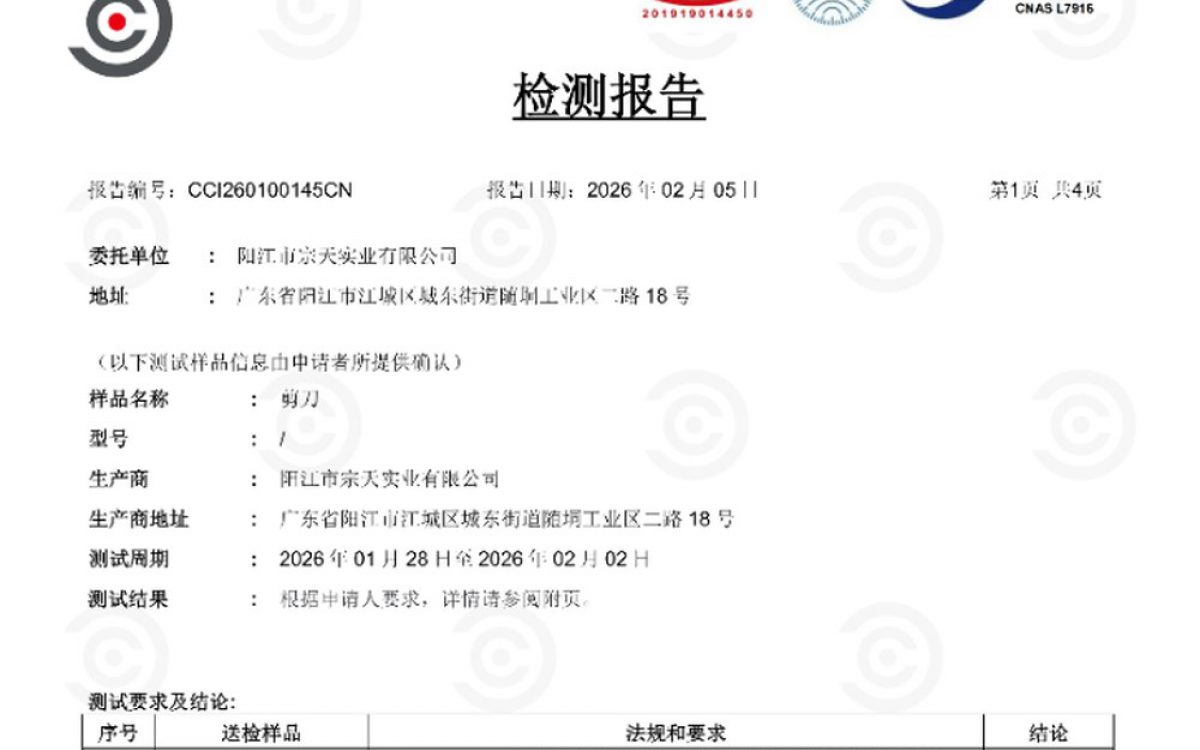
- The date and the accreditation of the laboratory.
A report that names only "stainless steel" without a grade cannot be relied on, because a different grade is a different material. See heavy metal migration testing.
The declaration of compliance
The declaration of compliance is the document a buyer or an authority asks for. For a metal article it should state:
| Item | Content |
|---|---|
| Issuer | The party making the declaration, with an EU address for a product on the EU market |
| Product identification | The product, and the materials it covers, by grade where applicable |
| Intended use | The food contact conditions it applies to |
| Legislation | The instruments referenced |
| Basis | The test reports and standards relied on, with dates |
| Restrictions | Any limitation, such as maximum temperature or the types of food |
| Date | Date of issue and a review cycle |
| Signature | Responsible person |
A declaration copied from another product, or one that lists a material different from the actual one, is worse than no declaration because it is a documented misstatement. Build the declaration from the actual material and the actual test report.
Where the food contact zone begins and ends
| Component | Usually in the food contact zone? | Comment |
|---|---|---|
| Blade and edge | Yes | The primary contact surface |
| Bolster | Yes | Contact during cutting and cleaning |
| Ferrule | Yes | Adjoins the blade and contacts food residue |
| Handle body | Partially | Contacts hands rather than food, but food residue and wash water reach it |
| Rivets and screws | Partially | Exposed on the handle surface |
| Handle coating or print | Partially | Must not transfer constituents or flake into food |
| Marking ink or etch residue | Yes if near the edge | Requires cleaning and a compliant process |
| Edge guard or sheath | No, but relevant | Not a food contact item; still must not transfer odour or contaminants to the knife |
| Retail packaging | No, but regulated separately | Packaging has its own regime. See packaging compliance |
The practical consequence is that a knife has several materials to justify, not one. Each material in or near the food contact zone needs its own compliance position: the blade steel, the bolster material, the handle material including any dye or finish, the rivet material, and any adhesive that could be exposed at a joint.
Common failure points
| Failure | Why it happens | Consequence |
|---|---|---|
| No declaration, or a generic one | The brand assumed the factory's paperwork was enough | Retail buyer rejects the listing; no defence if challenged |
| Test report for a different grade | Reuse of an existing report across a range | The report does not support the product |
| Report older than the material change | A grade or supplier was changed after testing | Documentation does not match the product |
| Wrong simulant or conditions | Testing performed to a generic protocol | Does not demonstrate compliance for the real use |
| Coating not covered | Only the substrate was tested | A PVD or printed handle coating is an untested material |
| Nickel issue on the handle | Food contact considered but skin contact ignored | Separate restriction applies. See nickel release |
| No EU responsible operator | A non-EU brand selling directly | Market surveillance cannot be satisfied |
| Claim on the pack with nothing behind it | Marketing text written by design, not by compliance | An unsubstantiated claim is itself an offence in the EU |
Building the compliance file for a knife
- List every material in the product with its grade and supplier.
- For each, obtain a material certificate or declaration from the supplier or mill.
- Identify which materials are in the food contact zone and which are skin contact only.
- Commission migration testing for the food contact materials, appropriate to the intended use.
- Commission nickel release testing if any exposed component contains nickel.
- Write the declaration of compliance from the actual test data.
- Confirm the labelling and the food contact statement on the pack.
- Retain everything for the required period and make it available on request.
- Review whenever a material, grade or supplier changes.
For a small brand, the cheapest route is to select a material set that already has valid reports held by the factory, verify the reports identify the material precisely, and then either adopt them with the factory's permission and a confirmation that the material has not changed, or commission one report covering the specific combination. One good report per material set is reusable across an entire range. See tooling and one-off costs for how to treat that as a reusable asset.
Related reading
Looking for a kitchen knife manufacturer?
We manufacture chef knives, knife sets, Damascus and steak knives in Yangjiang with OEM and private label service. Get a quote today.
Get Free Quote → Browse Products