China's GB 4806 Series: Food Contact Metal Standards Explained
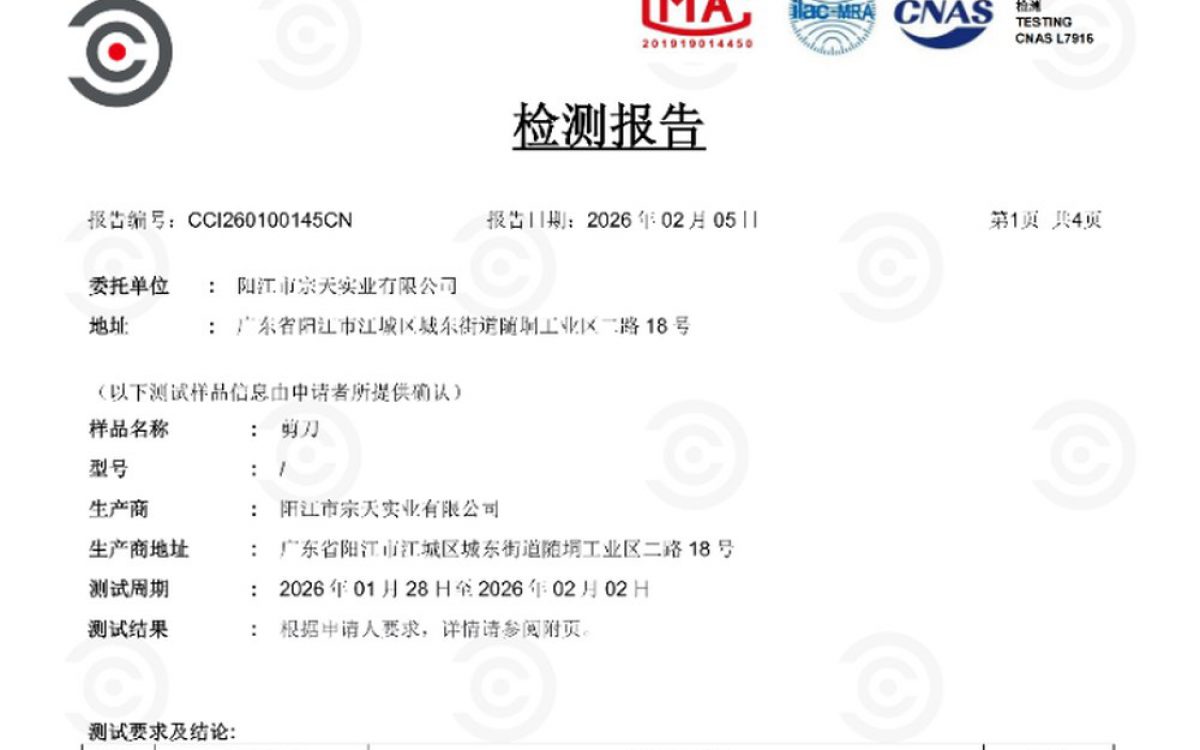
China's GB 4806 series is the domestic food contact framework, and it matters to an exporter for two reasons: it governs products sold in China, and it is a useful reference framework because its requirements for metals are explicit and testable. Many factories already hold GB test reports, and those reports can support a compliance position when used for what they actually cover.
This article explains the GB 4806 series as it applies to metal cutlery.
The structure of the series
| Part | Scope | Relevance to cutlery |
|---|---|---|
| GB 4806.1 | General safety requirements for food contact materials and articles | The overarching principles, including the requirement for a compliance statement |
| GB 4806.3 | Enamelware | Relevant if any enamel decorative element is used |
| GB 4806.4 | Ceramic articles | Not directly relevant, unless ceramic components are used |
| GB 4806.7 | Plastics | Applies to plastic handles and to any plastic in the food contact zone |
| GB 4806.9 | Metals and alloys | The key part for a steel blade, bolster and any metal handle element |
| GB 4806.10 | Paints and coatings | Applies to any coated surface |
| GB 4806.11 | Rubber | Applies to any rubber grip element |
| GB 4806.12 | Other materials, including wood, paper and bamboo | Applies to wooden handles and to some packaging materials |
| GB 31604 series | Test methods | The methods used to demonstrate compliance |
GB 4806.9 for metals and alloys
| Requirement | What it covers | Practical note |
|---|---|---|
| Material requirements | Permitted alloy composition for food contact metals | The grade must be within the permitted composition; some low-cost grades with high impurity levels are not |
| Migration limits | Limits for specific metals migrating into a food simulant | Explicit numeric limits, which makes the standard testable rather than judgement-based |
| Test conditions | Simulant, temperature and exposure time per the intended use | Defined in the standards rather than left to the laboratory |
| Exclusions | Some metallic components are excluded from the migration requirement in specified circumstances, for example certain components not in direct contact | Position in the contact zone determines applicability |
| Compliance statement | The product must be accompanied by information identifying the manufacturer, the material and the compliance basis | Required by GB 4806.1 |
The migration limits in GB 4806.9 are explicit and enforced, which makes the standard practically useful. A factory with a current GB 4806.9 report for a specific grade has demonstrated something concrete about that grade.
Other parts that apply to a kitchen knife
| Part | Applies when | What it requires |
|---|---|---|
| GB 4806.7, plastics | Plastic or polymer handle, or a plastic element in the contact zone | Permitted resin and additive list, overall and specific migration limits, sensory requirements |
| GB 4806.10, coatings | Any coating on the blade or handle, including decorative | Coating substance restrictions and migration requirements |
| GB 4806.11, rubber | Rubber or elastomer grip components | Formulation and migration requirements |
| GB 4806.12, others | Wooden handles, and materials not covered elsewhere | Requirements for the specific material, including treatment and additives |
| GB 4806.1, general | Always | General safety, sourcing of material, and the compliance information obligation |
Using a GB report for export markets
| Question | Answer |
|---|---|
| Does a GB report satisfy an EU buyer? | No. It is evidence that the material passed a defined test, but the EU requires its own framework compliance and declaration, and the test conditions and limits differ |
| Is a GB report useful evidence in the EU? | It is supportive evidence about the material, not a substitute for EU testing or a declaration |
| Does a GB report satisfy a US importer? | No. The US framework is different. It may be referenced as supporting material evidence |
| Is a GB report useful for a Chinese domestic claim? | Yes, it is the relevant scheme, together with the compliance statement |
| Can it reduce testing cost elsewhere? | Sometimes it can inform a risk assessment and reduce the scope of a required test, but do not present it as equivalence |
The common mistake is using a GB test report in a European sales conversation as if it were an LFGB or a declaration of compliance. It is not, and presenting it as such is a documentation error that a competent buyer will catch. See EU compliance and LFGB testing.
Practical standard selection
| Selling where | Primary requirement | Secondary, useful evidence |
|---|---|---|
| China domestic | GB 4806 series, with a compliance statement | Factory internal test data and process control records |
| European Union | Framework regulation compliance, declaration of compliance, EU responsible operator | LFGB or equivalent test report as supporting evidence |
| Germany specifically | Framework regulation plus LFGB expectations from retail | GB 4806.9 data as background |
| United States | No adulteration; supplier declarations for polymers and coatings; Prop 65 assessment | Any migration testing as supporting evidence |
| Japan | Food sanitation law requirements and Japanese labelling | Test data to the relevant Japanese specification |
| Gulf markets | Gulf standards and Saudi or Gulf conformity requirements | Testing to the applicable Gulf standard |
Testing scope for a metal knife under GB 4806
| Component | Applicable part | Test |
|---|---|---|
| Blade and bolster, in contact zone | GB 4806.9 | Migration of regulated metals into the specified simulant under the specified conditions |
| Plastic or polymer handle | GB 4806.7 | Overall migration, specific migration, sensory |
| Coated surface | GB 4806.10 | Coating specific requirements and migration |
| Rubber grip elements | GB 4806.11 | Formulation and migration requirements |
| Wooden handle | GB 4806.12 | Material specific requirements, including any treatment |
| Product information | GB 4806.1 | A compliance statement with the required information |
Verifying a factory's GB report
- Which part of the GB 4806 series does the report reference?
- Which material is named, and with what composition?
- What simulant and exposure conditions were used?
- Which elements were tested and what limits were applied?
- Is the report current, and has the material or supplier changed since?
- Does the report cover the contact zone components, or only the blade?
- Is there a compliance statement as GB 4806.1 requires?
- Will the factory permit the report to be referenced in your own documentation for a different market, clearly identified as a GB report and not as the destination scheme?
Question eight matters for honesty. A brand can reference supporting evidence, but it must not present a GB report as an EU or US compliance document. Misrepresenting the scheme is a fast way to lose a buyer's confidence when it is discovered. See auditing customer-facing facts.
Why the Chinese framework is worth knowing even if you do not sell in China
- It defines explicit limits for metal migration, which is a useful reference when evaluating a material.
- Many factories hold GB reports, which are a free source of material information.
- It demonstrates what a fully specified metal food contact standard looks like, which makes the EU position — a framework plus national measures plus a declaration — easier to understand.
- If your product is manufactured in China, domestic rules may apply to the factory's own compliance obligations independently of your destination market.
Related reading
Looking for a kitchen knife manufacturer?
We manufacture chef knives, knife sets, Damascus and steak knives in Yangjiang with OEM and private label service. Get a quote today.
Get Free Quote → Browse Products