LFGB Testing for Kitchen Knives: Scope, Test Items, Cost and Turnaround
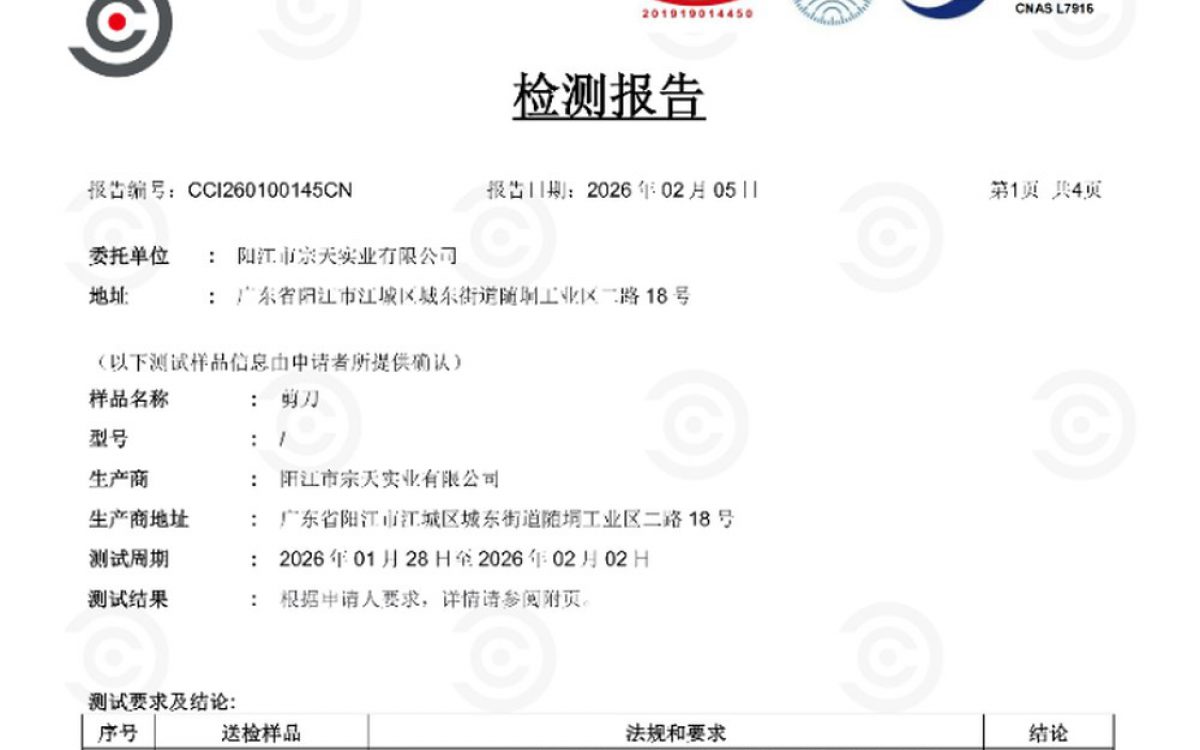
LFGB is a German national food contact framework, and it has become the default testing standard that European retail buyers ask for even outside Germany. Understanding what it tests, what it costs and what it does not cover prevents both over-testing and a false sense of security.
This article explains the LFGB position for kitchen knives, the practical scope, and how to commission testing sensibly.
What LFGB is
| Aspect | Detail |
|---|---|
| Full context | Food and Feed Code of the Federal Republic of Germany, and the associated recommendation documents for food contact materials |
| Status | A national requirement, widely adopted by European retail as a de facto specification |
| Role in the EU framework | National measures operate alongside the EU framework regulation; LFGB is the most commonly requested national scheme |
| Certification | There is no "LFGB certificate" issued by a government body. What exists is a test report from a laboratory, often with a statement of conformity |
| What it demonstrates | That the tested article meets the migration and sensory requirements applied by the laboratory under the specified conditions |
| What it does not demonstrate | That every unit of a batch performs identically, or that the tested article matches the production article if the material changed |
What testing typically covers for a knife
| Test category | What is examined | Relevance to a knife |
|---|---|---|
| Heavy metal migration | Migration of metals into a food simulant under specified conditions | The core test for the blade and any metal part in contact with food |
| Sensory or organoleptic testing | Whether the article imparts taste, odour or colour | Relevant for coated or printed components and for new handle materials |
| Overall migration | Total mass transfer | More relevant to plastics; sometimes requested in combination |
| Specific migration of individual components | Named substances | Relevant where a handle polymer contains additives of interest |
| Nickel release | Release from articles in prolonged skin contact | A separate test normally under the REACH restriction; often combined in European programmes |
| Colour fastness and transfer | Whether a dye or print transfers | Relevant for coloured handles and printed surfaces |
| Formaldehyde and other specific substances | Where the material is susceptible | Occasionally relevant for some handle materials and bonding systems |
Scope: which components need testing
| Component | In food contact zone | Typical testing | Cost driver |
|---|---|---|---|
| Blade steel | Yes | Heavy metal migration under a defined simulant and exposure regime | Number of elements and exposures |
| Bolster and ferrule | Yes | Heavy metal migration | Usually combined with the blade if the same material, separate if not |
| Handle polymer | Partially | Overall and specific migration, sensory | Number of components to identify |
| Handle wood | Partially | Sensory, and specific substances where a treatment is applied | Treatment chemistry must be disclosed |
| Coating on blade or handle | Yes if in the contact zone | Migration from the coating | Coating chemistry and thickness |
| Rivets and screws | Partially | Migration if exposed and in contact | Material |
| Adhesive at a joint | Potentially | Migration if it could be exposed | Adhesive chemistry |
| Print or marking ink | Potentially | Migration and transfer | Ink formulation |
The most common inefficiency is testing a whole knife when the compliance question is about one component, or testing one component when the question is about the interaction. The right approach is to group tests by material and by whether the material is in the contact zone. A single blade of a given grade tested under the right conditions covers every knife in a range using that grade, provided nothing else in the contact zone differs.
Cost and turnaround reality
| Scope | Relative cost | Typical turnaround | Reuse potential |
|---|---|---|---|
| Heavy metal migration, blade steel only | Low | Roughly one to two weeks | High — covers the whole range in that grade |
| Full knife, blade plus handle plus coating | Moderate | Two to four weeks | Moderate — per material combination |
| Add nickel release | Low to moderate increment | Adds a short period | Reusable per material |
| Add sensory and colour fastness | Low increment | Adds a short period | Reusable per material |
| New polymer handle with multiple additives | Higher | Longer, because of component identification | Reusable per material |
| Testing in a rush | A surcharge is common | Compressed | Not relevant |
Concrete numbers depend on the laboratory, the element list and the number of exposures, and they change with the market. The important structural point is that testing a single grade of steel is cheap relative to testing a whole assembled product with several materials, and the result is reusable across a range. Treat the report as a durable asset, not a per-product expense. See one-off cost amortisation.
Design decisions that reduce testing scope
| Decision | Effect on testing |
|---|---|
| One steel grade across the range | One migration report covers every knife in that grade |
| One handle material across the range | One handle test covers every SKU |
| No blade coating | Removes a whole test category |
| Uncoloured, unprinted handle | Removes colour fastness and transfer testing |
| Blade steel already tested by the factory with a valid report | Can avoid a new test entirely, subject to verification and permission |
| Adhesive fully enclosed in the joint | May remove the adhesive from the contact zone assessment |
| Introduction of a PVD coating | Adds a test category, plus determination of the coating composition |
Verifying a factory's existing report
Factories frequently hold LFGB reports and offer to share them. Before relying on one, check:
- Does the report name the material precisely, with a grade?
- Does the material match what is being supplied now?
- Does the report identify the supplier or the mill?
- Are the test conditions appropriate for a kitchen knife — the simulant, temperature and exposure regime?
- Is the report still valid, and has the factory changed supplier since?
- Does the report cover all elements of concern, or only some?
- Does the report cover the handle and any coating, or only the metal?
- Will the factory allow the report to be referenced in the brand's declaration of compliance?
A report that answers all eight is worth more than a new test, because it is already available and it saves both cost and weeks. A report that fails any of the first four is not evidence of anything about the product being bought.
What LFGB does not do
- It does not certify the factory.
- It does not cover the packaging, which has its own regime. See packaging compliance.
- It does not replace the EU declaration of compliance, which still has to be issued by the responsible operator. See EU food contact compliance.
- It does not cover performance, sharpness, durability or safety claims.
- It does not guarantee batch consistency. That comes from a material control system at the factory. See in-process quality control.
The last point matters. A migration test on a sample demonstrates that the material is capable of complying. It does not demonstrate that every production batch uses the same material. The test is a material qualification; batch consistency comes from the factory's incoming material control and traceability. If both exist, compliance is defended. If only the test exists, the first batch substitution defeats it.
Practical approach
- Decide the material set and freeze it before commissioning testing.
- Check whether the factory holds a valid report for each material before paying for new tests.
- Test by material, not by product, wherever possible.
- Include the handle and any coating or print in the scope.
- Add nickel release if any exposed component contains nickel.
- Record the report in the declaration of compliance and in the compliance file.
- Require the factory to notify you before changing any material or supplier, and treat that as a trigger for re-verification.
Related reading
Looking for a kitchen knife manufacturer?
We manufacture chef knives, knife sets, Damascus and steak knives in Yangjiang with OEM and private label service. Get a quote today.
Get Free Quote → Browse Products