MOQ, Tooling and Sample Costs for Custom Kitchen Knives: What Actually Drives the Price
"What is your MOQ?" is the first question most buyers ask and the one that most often gets a useless answer. A number without context — 500 pieces? per model, per colour, per box, per order? — tells you nothing about whether a programme is viable.
This guide explains what drives MOQ, what tooling really costs, and where the money actually goes when you customise a kitchen knife.
Why MOQ exists, in one paragraph
Every knife model has setup costs that do not change with quantity: programming the CNC grind, setting the press or forge die, loading the furnace with a viable batch, mixing a handle compound or running a mould, setting up the laser for a logo, and printing a box. Those costs have to be spread across the pieces in the order. Below a certain quantity, the setup cost per piece becomes so large that the price is no longer competitive — so the factory declines, or quotes a number that makes the order uneconomic on purpose.
Where the money goes
| Cost | Typically one-off? | Drivers | What it means for you |
|---|---|---|---|
| Blade blanking die or laser program | One-off, reusable | Profile complexity, whether a press die is required | Ask who owns the die and whether it is stored for your reorders |
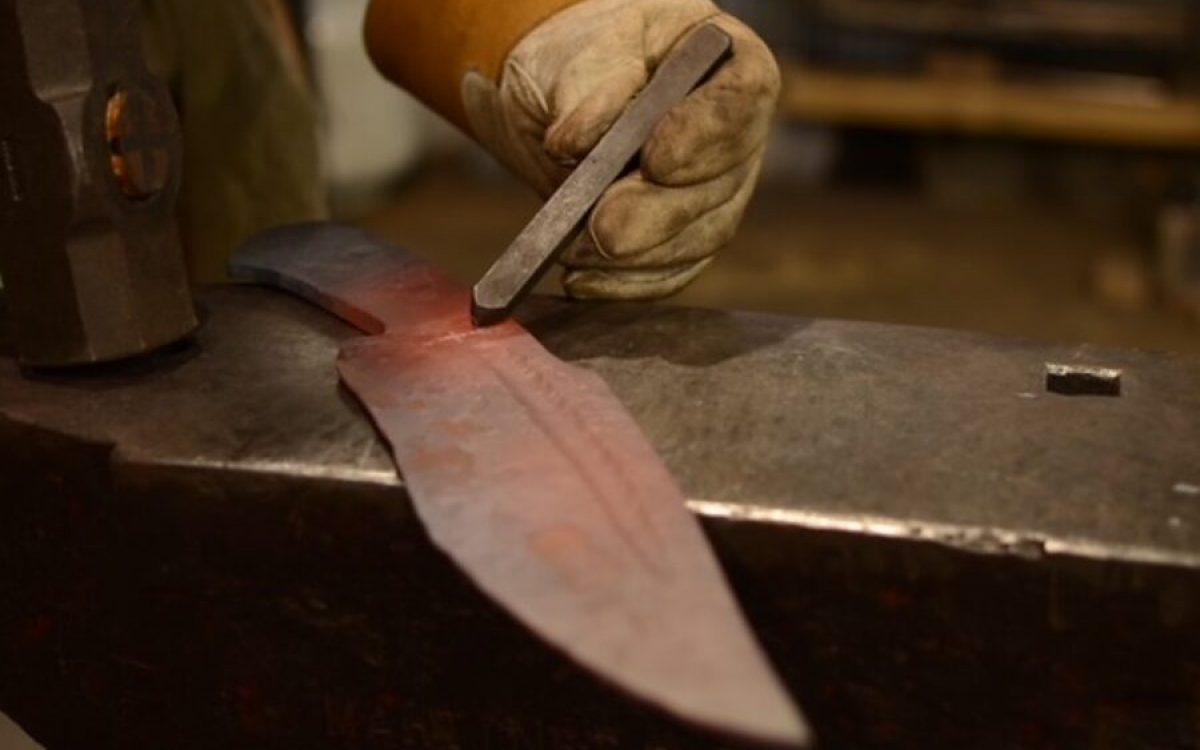
| Forging die | One-off, expensive | Forged construction, die size, whether bolster is integrated | The main reason forged custom models carry a higher MOQ |
| Handle mould (for injection-moulded or cast handles) | One-off, expensive | Part count — two-piece scales cost more than a single moulding | Wood and composite scales avoid mould cost entirely; they are cut and shaped |
| Logo setup | Low one-off | Laser (file only) vs etching artwork vs pad print plate | Laser marking has the lowest setup of the three |
| Box and print | One-off per version | Printing method, colour count, whether a die-cut insert is needed | Packaging tooling is often the largest hidden cost in a low-volume programme |
| Samples | Per iteration | Whether hand samples, pre-production samples or both are required | Budget for two rounds, not one |
Typical MOQ structure by order type
| Programme | Blade | Handle | Packaging | Indicative MOQ |
|---|---|---|---|---|
| Existing model, your logo only | Standard catalogue | Standard | Standard or simple printed box | Lowest — sometimes a few hundred total |
| Existing model, custom handle colour or material | Standard | Material change, no new mould | Printed box | Low to moderate, per model and per colour |
| New blade profile, stamped | New blanking tool | Standard or cut scales | Printed box | Moderate — tooling amortisation drives it |
| New forged model | New forging die | New scales or mould | Custom | Highest — die cost dominates |
| Full set in a block or gift box | Several models | Several | Box plus insert, sometimes a block | Quoted per set, not per knife |
The columns matter as much as the number. MOQ is usually per model, per colour, per packaging version. A "1,000 piece" MOQ across four colours and two box versions can turn into eight separate minimums.
Getting from a project idea to a first order
- Send a clear brief — blade type and length, steel grade, target hardness, handle material, target price band and target quantity. Our steel grade guide helps specify the grade.
- Ask for a standard-model quote first. Before custom tooling, find out what the closest existing model costs. This sets the reference price and tells you how much the customisation is really buying.
- Confirm which existing models can take your logo immediately. For a first market test, laser-marking an existing model is the cheapest possible entry — no tooling at all.
- Only then decide on tooling. Custom tooling should be a second-order decision, made once the range has proven it sells.
Sample costs: what to expect and what to ask
- Stock samples of catalogue models are usually supplied at low cost or free, with the buyer paying courier. This is the cheapest way to assess a factory.
- Customised samples carry real cost — hand-made or pre-production, plus the tooling if the sample requires it. Expect to pay, and expect a refundable-against-order arrangement to be negotiable.
- Ask what "refundable" means. Refunded against the first production order, or against tooling only? Written terms, not verbal.
- Get two iterations. The first custom sample is a prototype; the second confirms you actually fixed what was wrong.
Tooling ownership — do not skip this
If you paid for a die, a mould or a print plate, settle three things in writing before the money moves:
- That the tooling is your property.
- Where it is stored and who may use it.
- What happens to it if you move your order to another supplier — will it be released, at what cost or condition.
Factories that treat tooling as theirs by default are common. It is not a sign of bad faith; it is simply a term that nobody wrote down. Write it down.
How to lower cost without wrecking quality
| Lever | Effect on cost | Risk to watch |
|---|---|---|
| Share one blade blank across several SKUs | High — one tool, several products | Products feel too similar on shelf |
| Standardise the steel grade across the range | Moderate — better coil buying, stable heat treatment | Cuts off differentiated hero SKUs, so exempt the flagship |
| Move from blister to fibre sleeve on the entry SKU | Moderate | Less retail presence; check whether the channel needs visibility |
| Reduce blade thickness with geometry adjustment | Moderate | Must adjust the bevel, or the blade flexes. See edge geometry |
| Consolidate to fewer colours | Moderate — fewer minimums stack up | Colour variety is often the main driver of repeat purchase |
| Drop hardness a point to reduce grinding time | Low | Usually a false economy — edge retention and the brand both suffer |
FAQ
Can MOQ be negotiated?
Sometimes, and the leverage is a clear long-term plan. A supplier will often accept a lower first order for a customer who commits in writing to a follow-on volume and accepts a small price premium on the first run. What does not work is asking for a lower MOQ without changing anything else.
Is the sample cost refundable?
Often, against the first production order. Get the exact terms in writing — "refundable" means different things to different people.
Should I pay for tooling up front?
Normally yes, tooling is paid before it is made, because it cannot be reused for anyone else. Pay in stages against photographic evidence of the tool, not as a single transfer at the start.
Why is a knife set a different MOQ from a knife?
A set is assembled from several models plus a box or a block. The constraint is usually the packaging component with the largest minimum — often the block or the insert — not the knives.
Looking for a kitchen knife manufacturer?
We manufacture chef knives, knife sets, Damascus and steak knives in Yangjiang with OEM and private label service. Get a quote today.
Get Free Quote → Browse Products