Heat Treatment Furnaces for Cutlery: Salt Bath, Vacuum and Continuous Lines
Heat treatment is the step that decides whether a good steel becomes a good knife. It is also the step a brand can least easily inspect, because the evidence is metallurgical rather than visible. Understanding the equipment tells a buyer which questions are worth asking and which answers are credible.
This article explains the main heat treatment routes available to cutlery factories, with their capabilities, limits and cost implications.
Equipment compared
| Equipment | Atmosphere | Temperature uniformity | Distortion | Surface after treatment | Cost | Typical use in cutlery |
|---|---|---|---|---|---|---|
| Box furnace, air atmosphere | Air | Fair | Moderate to high | Heavy scale, decarburisation risk | Lowest | Low-end production, low-cost grades |
| Box furnace with controlled atmosphere | Nitrogen or endothermic gas | Good | Moderate | Clean, minimal decarburisation | Moderate | General cutlery production |
| Salt bath | Molten salt | Excellent | Lower, but salt drag | Clean, needs salt removal | Moderate | Fast heating; useful for thin blades and for austempering |
| Vacuum furnace | Vacuum, partial pressure | Excellent | Low, with controlled gas quench | Bright, no oxide | High | Premium blades; high-alloy and powder steels |
| Continuous mesh belt furnace | Controlled atmosphere | Good | Moderate, parts can touch | Clean | Moderate, high throughput | High-volume cutlery lines |
| Continuous pusher or roller hearth | Controlled atmosphere | Good | Low, if fixtured | Clean | Moderate to high | Large volumes with fixture requirements |
| Induction heating | None needed locally | Local | Low for local hardening | Clean, localised | Moderate | Local hardening of a section, not a whole blade usually |
Box furnaces
The simplest and most common route. Blades are loaded into a furnace, held at austenitising temperature, then quenched — often by an operator moving the load to an oil or polymer tank, sometimes by a mechanised quench.
| Advantage | Limitation |
|---|---|
| Low capital and low running cost | Temperature uniformity depends on furnace design and loading |
| Flexible batch sizes | Scale and decarburisation in an air atmosphere unless controlled |
| Easy to operate | Quench transfer time from furnace to tank is manual and variable |
| Suited to a wide range of grades | Distortion is harder to control |
The transfer time between furnace and quench is the critical uncontrolled variable in a manual box furnace operation. A slow transfer means the blade cools below the critical temperature before quenching, producing lower hardness and a coarse transformation product. Ask how the transfer is performed and how long it takes. An honest answer that describes a manual tong operation with a stated time is more reassuring than a claim of precision.
Decarburisation is the other box furnace issue. In an air atmosphere, surface carbon is burned away, leaving a soft skin. On a thin blade with a fine edge this matters: the decarburised layer may be a significant fraction of the edge thickness. Controlled atmosphere or a protective coating addresses it. A brand buying a value product from an air-atmosphere box furnace should expect to lose some material in grinding and should expect the hardness specification to be verified below the surface.
Salt bath
Molten salt heats by conduction and radiation with very high heat transfer coefficients, so the blade reaches temperature quickly and uniformly. Two consequences:
- Fast and uniform austenitising. Short soak times reduce grain growth and decarburisation, which suits thin sections.
- Isothermal quench possibilities. Quenching into a salt bath held at a specific temperature enables austempering or martempering, which reduces distortion and cracking relative to a straight oil quench.
| Advantage | Limitation |
|---|---|
| Excellent temperature uniformity and fast response | Salt drag out — the blade carries salt which must be washed |
| Low decarburisation | Salt handling, safety and disposal obligations |
| Enables austempering and martempering | Salt bath chemistries are specific; not all grades suit all salts |
| Suits thin and long sections | Operator training and safety are demanding |
Residue is the quality issue. If a blade is not thoroughly desalted and washed, residual salt on a food contact surface is both a hygiene and a corrosion problem. This should be a specified step with a rinse and a verification. See migration testing and corrosion.
Vacuum furnaces
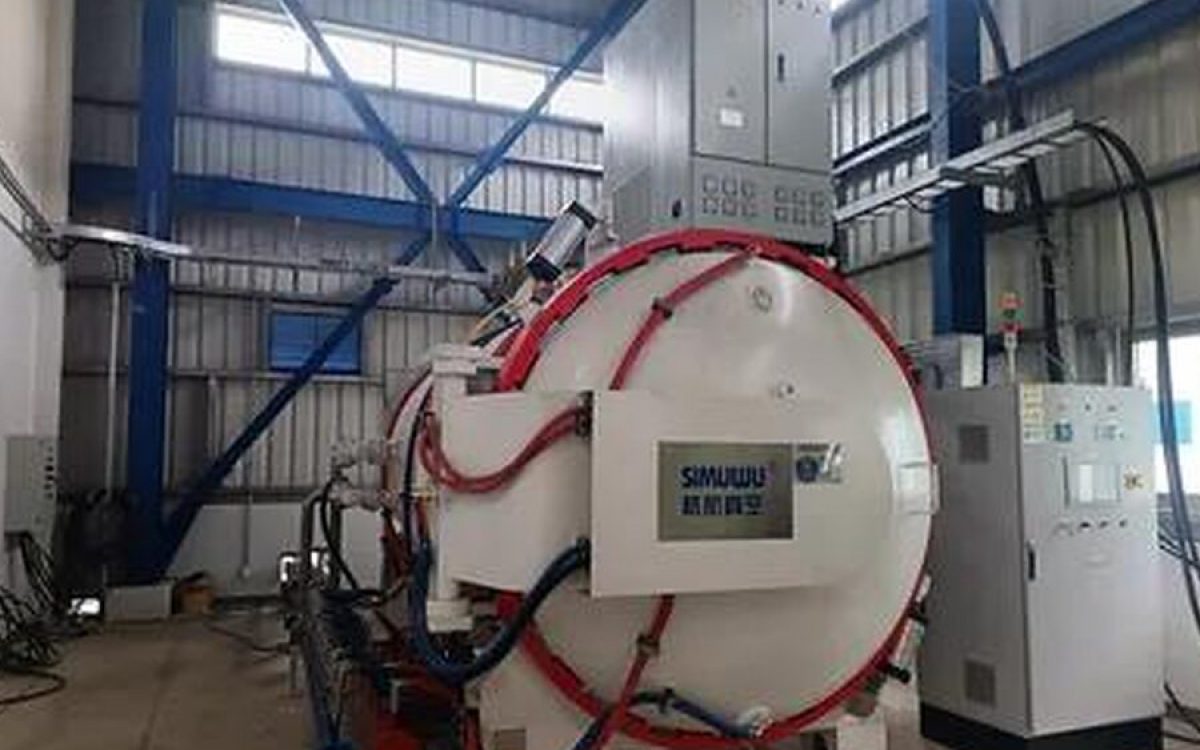
Vacuum heat treatment removes the atmosphere problem entirely. There is nothing to decarburise the surface and nothing to oxidise it, so the blade emerges bright.
| Advantage | Limitation |
|---|---|
| No decarburisation, bright surface, less post-treatment | High capital and running cost; batch vacuum cycles are slower |
| Excellent uniformity and repeatability | Gas quench capability determines the hardenability of grades that can be processed |
| Very repeatable, good for high-value products | Not economical for low-cost, high-volume products |
| Suits high-alloy and powder metallurgy steels | Vacuum quenching of low-hardenability grades needs high gas pressure |
| Vacuum carburising can be used where a carbon gradient is wanted | Not relevant for knife blades |
For premium blades in high-vanadium or high-chromium grades, vacuum is often the only route that reliably reaches the required hardness without surface degradation. If a factory claims a 61 HRC premium blade on a high-alloy steel and heat treats in an air box furnace, the claim deserves scrutiny.
Continuous lines
A continuous furnace trades flexibility for throughput and consistency. Parts move through heating, soaking and quenching zones on a belt or a fixture.
| Advantage | Limitation |
|---|---|
| Consistent cycle, every part sees the same thermal history | Economical only at volume; the line must run full to be efficient |
| Lower labour per part | Fixturing requirements; parts may touch and mark |
| Integrated quench with controlled timing | Less flexible for varied shapes and thicknesses |
| Good for high-volume, stable products | Changing product requires setup and possibly new fixtures |
Continuous lines are characteristic of factories that make large volumes of a narrow product family. If a factory has a continuous line, they are built for volume, and small custom orders will either be priced defensively or scheduled around. That is useful context when interpreting a lead time.
Cryogenic treatment
| Aspect | Detail |
|---|---|
| What it is | Holding the quenched blade at low temperature — commonly in the range of −80 °C to −196 °C depending on equipment |
| What it does | Converts retained austenite to martensite, which improves dimensional stability, hardness and often wear resistance |
| When it matters most | High-carbon and high-alloy grades, where retained austenite is more likely |
| When it matters less | Low-carbon, low-alloy grades where little austenite is retained |
| Sequence | Quench, cryogenic hold, then temper. Tempering before cryogenic is a mistake because it stabilises the austenite |
| Common abuse | A short pass through a cold chamber presented as a full cryogenic treatment |
A brand cannot easily verify a cryogenic cycle without seeing the records. What it can do is require a temperature-time record per batch and require that retained austenite, where relevant, is below a stated maximum. This converts a marketing word into a specification.
Tempering and number of cycles
| Practice | Effect | When appropriate |
|---|---|---|
| Single temper | Adequate for many simple grades | Low-alloy, moderate hardness products |
| Double temper | More complete stress relief and austenite conversion; better toughness consistency | High-alloy and high-hardness products |
| Temper after cryogenic | Required — cryogenic converts austenite, tempering then settles the structure | Whenever cryogenic is used |
| Low-temperature temper | Maximises hardness, reduces toughness | Enthusiast edges where hardness is the priority |
| Higher-temperature temper | Better toughness at some hardness cost | Hard-use knives, cleavers, knives that get abused |
What to specify and what to record
| Item | Specify | Record |
|---|---|---|
| Austenitising temperature and soak time | A range | Furnace chart or cycle log per batch |
| Atmosphere | Air, controlled, salt or vacuum | Equipment identification |
| Quench medium and transfer time | Medium and maximum transfer time | Process instruction |
| Cryogenic treatment | Temperature, hold time, plus a record requirement | Cycle log |
| Tempering | Number of cycles, temperature, duration | Cycle log |
| Hardness | Target range, test location relative to the edge, sample size, method | Test results per batch |
| Distortion | Straightness tolerance after treatment | Measurement records |
| Surface condition | Scale or decarburisation limits, and how much material is removed after treatment | Inspection records |
The single most useful question to ask a factory: do you heat treat in-house or outsource, and can I see a cycle record for a batch? A factory with records is a factory with a quality system. A factory that cannot produce one is producing parts, not products. See the metallurgy of heat treatment and in-process quality control.
Related reading
Looking for a kitchen knife manufacturer?
We manufacture chef knives, knife sets, Damascus and steak knives in Yangjiang with OEM and private label service. Get a quote today.
Get Free Quote → Browse Products