Social Compliance Audits for Cutlery Suppliers: BSCI, Sedex SMETA and Retailer Programmes
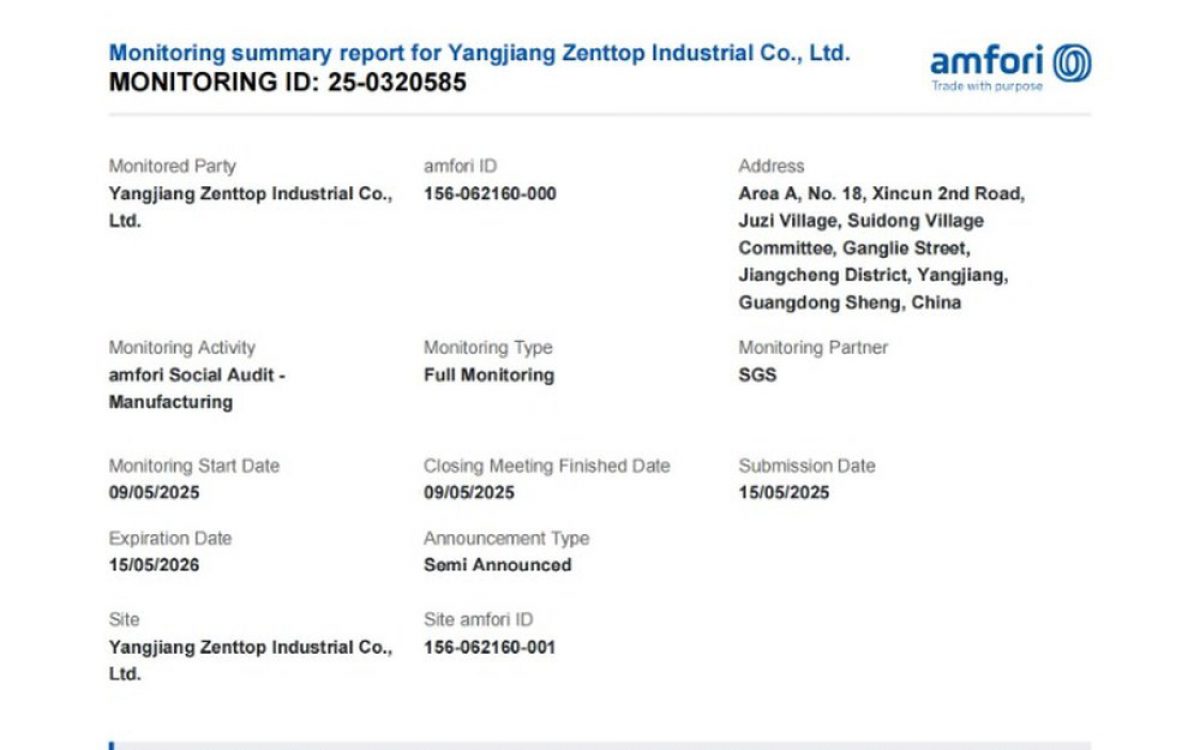
Social compliance is now a condition of doing business with most Western retailers, and for a cutlery factory it is a substantial management burden. For a knife brand, understanding what these audits actually assess tells you how much weight to put on them and what to ask for.
This article covers the main programmes, what they assess, and how a buyer should interpret the results.
The main programmes
| Programme | Who runs it | Format | Typical validity | Used by |
|---|---|---|---|---|
| BSCI | A business-driven social compliance initiative | Audit against a code, with a graded rating | Commonly one year, depending on the rating | European retailers and brands |
| Sedex SMETA | A membership platform with a common audit methodology | Audit with a report shared through the platform | Varies by buyer requirement | UK and European retailers |
| SA8000 | An international social accountability standard | Certification scheme with a defined standard | Typically three years with surveillance audits | Brands with a strong social agenda |
| Retailer-specific programmes | Individual retailers | Own code and audit protocol | Varies | The retailer's own supply base |
| ICTI and similar sector schemes | Sector bodies | Sector-specific code | Varies | Sector buyers |
| WRAP | A responsible production programme | Certification against a set of principles | Typically one year | Apparel and consumer goods buyers |
| Customer's own audit | The buyer | Direct audit | Per the buyer's policy | Larger brands |
What an audit assesses
| Area | What is examined | Common findings in factories |
|---|---|---|
| Working hours | Records of hours worked, rest days, overtime | Excessive overtime; inadequate rest days in peak season; records that do not match reality |
| Wages | Pay records, minimum wage compliance, overtime rates, deductions | Overtime calculated incorrectly; deductions not permitted |
| Child labour and young workers | Age documentation, jobs assigned to young workers | Incomplete age records; young workers on hazardous operations |
| Forced labour | Freedom to leave, retention of documents, recruitment fees | Document retention; recruitment fee arrangements through intermediaries |
| Health and safety | Machine guarding, personal protective equipment, chemical handling, fire safety, emergency exits | Missing guards on grinding equipment; inadequate dust and fume extraction; blocked exits |
| Chemical safety | Storage, labelling, handling, and controls for coolants, polishing compounds and treatment chemicals | Unlabelled containers; inadequate ventilation |
| Freedom of association | Worker representation and grievance mechanisms | Absence of any mechanism |
| Discrimination | Hiring and treatment practices | Documented policies without evidence of practice |
| Management systems | Policies, responsible persons, records | Policies copied from a template |
| Environment | Sometimes included, depending on the scheme | Waste and wastewater handling. See energy and environment |
What is genuinely relevant to a cutlery factory
| Area | Why it matters for knives specifically |
|---|---|
| Machine guarding on grinding and polishing stations | The highest-risk operation in a cutlery plant |
| Dust and fume extraction | Grinding dust and polishing fume are inhalation hazards |
| Hand injury prevention | Sharp edges at every stage |
| Noise | Grinding and stamping are loud operations |
| Chemical handling of treatment salts, coolants and polishing compounds | Real exposure routes |
| Ergonomics | Repetitive standing work at grinding and finishing |
| Working hours in peak seasons | Overtime spikes before holiday shipping deadlines, which coincide with your own delivery schedule |
The last item matters commercially as well as ethically. A factory that meets a peak-season delivery promise partly through excessive overtime is also a factory where quality is likely to drop in that same period. Fatigue and rushed work produce cosmetic defects and dimensional drift. A social audit finding on working hours is therefore also a quality signal.
Reading an audit result
| Element | What to look for |
|---|---|
| Rating or grade | Schemes use graded outcomes; understand what the top grade means and whether it permits findings |
| Open findings | Findings that have not been closed are the substance of the report |
| Finding severity | Zero tolerance findings versus minor findings; the classifications differ by scheme |
| Corrective action plan | Does one exist, with dates and owners? |
| Audit date | How old is it, and has anything changed since? |
| Scope | Which site, and does it cover the production of your product? |
| Auditor | Which body, and are they accredited for the scheme? |
| Follow-up audit | Has a follow-up been conducted to verify closure? |
| Unannounced element | Some schemes include unannounced audits; these are more informative than announced ones |
A high grade with open zero-tolerance findings is not a green light. A moderate grade with all findings closed and a dated corrective action record is a better position than a top grade obtained before a problem was identified.
Announced versus unannounced audits
| Type | What it captures | Limitation |
|---|---|---|
| Announced | The factory's ability to present a compliant state | Records can be prepared; conditions can be temporarily improved |
| Semi-announced | A window is given, typically narrow | Better than fully announced, still preparable |
| Unannounced | A more representative view of normal operation | Expensive and less common; requires an immediate capacity to audit |
| Buyer's own visit | What the buyer happens to see | Not a structured audit; a visit is a snapshot |
A buyer's own factory visit is not an audit, but it is useful and cheap. Walking the floor and looking at whether guards are on machines, whether extraction is running, whether workers have protective equipment and whether exits are clear tells you more about the daily reality than a certificate issued eight months ago.
The commercial realities
| Reality | Implication for a brand |
|---|---|
| Audits cost the factory money and time | Factories in the supply base of major retailers already hold audits; a small brand benefits from them at no cost |
| Audit validity is time limited | Check the date; a lapsed audit is a gap in the retail requirement |
| Some buyers accept a shared audit | Platforms allow audit sharing, so a factory with one good audit can serve several buyers |
| A social requirement can disqualify a cheaper factory | Cost comparisons must account for whether the factory can be sold to the target buyer at all |
| Social and quality performance are correlated but not identical | A compliant factory can still produce poor knives |
| Small brands can be refused | A factory with no spare audit capacity may decline a buyer whose order does not justify a new audit |
Practical approach for a knife brand
- Establish whether your target buyers require a social audit, and which scheme.
- When shortlisting factories, ask which audits they hold, with the scheme, date, rating and scope.
- Read the findings, not only the rating.
- Ask for the corrective action plan and evidence of closure.
- Include the social requirement in your supplier evaluation, weighted appropriately for your target market.
- Walk the floor on a visit and check the items that matter for cutlery: machine guarding, extraction, protective equipment, exits, working hours evidence.
- Re-verify the audit status annually, and after any reported incident.
- Consider whether you need your own position: a brand selling into European retail may itself be asked for a supply chain due diligence statement.
Related reading
Looking for a kitchen knife manufacturer?
We manufacture chef knives, knife sets, Damascus and steak knives in Yangjiang with OEM and private label service. Get a quote today.
Get Free Quote → Browse Products