Factory System Certifications: ISO 9001, ISO 14001 and ISO 45001 Explained
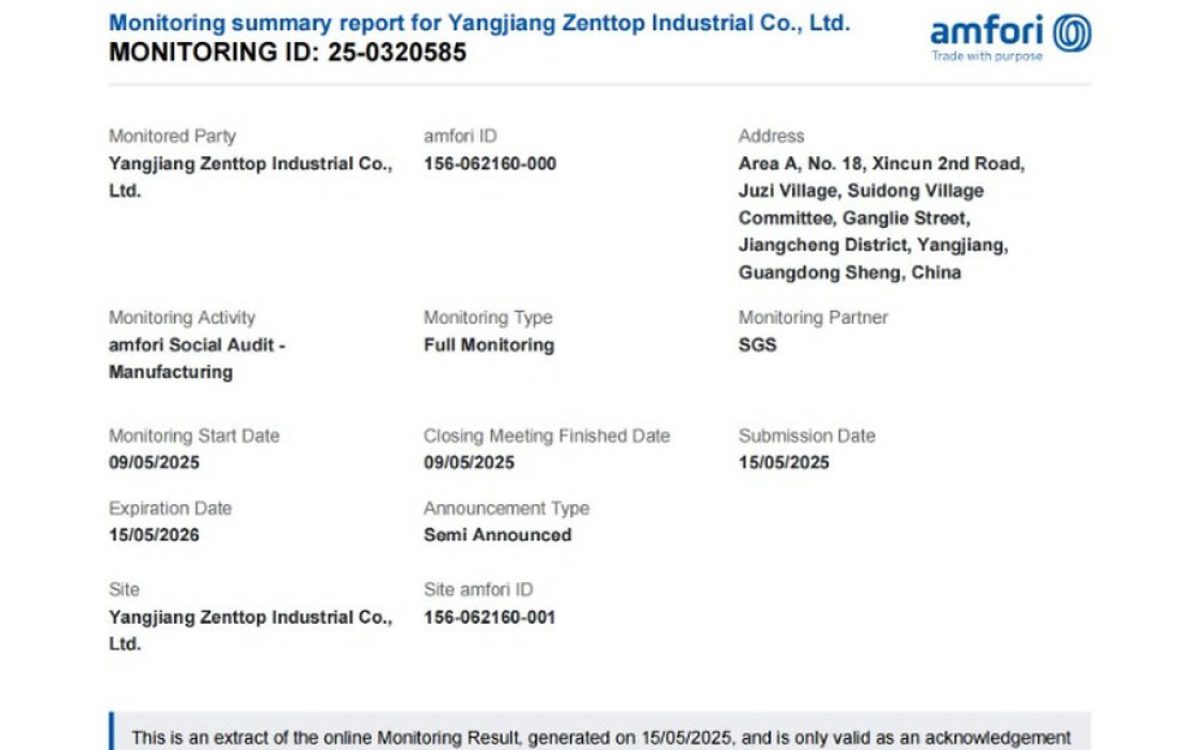
A factory's certificates are the most quoted and least examined documents in sourcing. Buyers treat a certificate as a guarantee; certificates are in fact a statement about a management system at a point in time, valid for a defined scope, and worthless if the scope does not cover the product you are buying.
This article explains what each common certification actually means for a cutlery supplier, and how to check whether a certificate is worth anything.
The common certifications
| Standard | What it certifies | What it does not certify | Relevance to a knife buyer |
|---|---|---|---|
| ISO 9001 | A quality management system meeting the standard's requirements | Product quality, dimensional accuracy or performance | Indicates the factory has documented processes, records and corrective action. Useful but not a product guarantee |
| ISO 14001 | An environmental management system | Environmental performance below any particular level | Indicates environmental aspects are identified and managed. Increasingly relevant to retail customer requirements |
| ISO 45001 | An occupational health and safety management system | A safe workplace | Relevant to social compliance questionnaires and to buyer risk assessment |
| ISO 22000 or FSSC 22000 | Food safety management | That the product is food safe | Usually applies to food manufacturers, not to a cutlery factory. Occasionally relevant where a factory also makes food contact articles under a food safety framework |
| ISO 13485 | Medical device quality management | Anything about kitchen knives | Relevant only if the factory also makes medical instruments. Sometimes cited as a competence signal |
| ISO 50001 | Energy management | Low energy consumption | A positive indicator for buyers needing energy data |
| BSCI, Sedex SMETA and similar social audits | Labour and social practices at a point in time | Continuing compliance; a good working environment | Required by many European retailers. See social compliance |
| Retailer-specific programmes | Compliance with a specific buyer's requirements | Anything outside that programme | Useful as a signal that the factory has passed a demanding audit |
| Chain of custody certification for wood and paper | That certified material is traceable through the supply chain | That the product contains certified material unless a claim is made correctly | Relevant to wooden handles and packaging claims |
| Product certification for food contact, where available | The product or material tested | Production consistency | More useful than a system certificate for a compliance conversation. See LFGB testing |
What ISO 9001 means in a cutlery factory
| What it should mean | What it often means in practice |
|---|---|
| Documented procedures for each key process | Procedures exist and are followed inconsistently |
| Records for inspections and tests | Records exist and are completed at the end of a shift rather than as work happens |
| Corrective action for nonconformities | A log exists with entries, sometimes without closure |
| Supplier evaluation | A list of approved suppliers, sometimes without criteria |
| Internal audit | Performed, sometimes as a paperwork exercise |
| Management review | Held, sometimes with the same agenda each time |
| Control of measuring equipment | A calibration schedule, sometimes with missing entries |
| Traceability | Often the weakest element in practice |
The value of ISO 9001 to a buyer is that it forces the factory to have records. That means the factory can answer questions about what happened in a specific batch. It does not mean the product is good. A factory can hold a valid certificate and produce a knife with a soft edge, because the standard governs the system, not the specification.
Making a certificate useful
| Question | Why it matters |
|---|---|
| Is it current? | Certificates are time limited; a lapsed certificate is not evidence of anything |
| What is the scope statement, in full? | A scope may cover one product family or one site. A knife factory with a scope limited to another product line is not certified for knives |
| Which site is covered? | Multi-site companies often hold certificates per site; the certificate may cover a different building from the one making your product |
| Who issued it? | Accredited certification bodies can be verified. Some certificates are issued by organisations without accreditation |
| Can it be verified independently? | Most accredited bodies publish a certificate register. Verification takes minutes |
| Is the certificate number and expiry on it? | Allows verification |
| Does it match the legal entity on the contract? | A certificate for a different legal entity is not a certificate for your supplier |
The scope statement is where most misunderstandings sit. A trading company or an export intermediary does not normally hold a manufacturing certificate, and offering one belonging to a partner factory is a different statement from holding it. When a supplier presents a certificate, ask whose name is on it and confirm that the named entity is the one that will manufacture the goods.
Environmental certification in practice
| Certificate | What it indicates | What to verify |
|---|---|---|
| ISO 14001 | Environmental aspects identified and managed | Scope, site, validity |
| ISO 50001 | Energy management system | Whether energy data is actually recorded and available |
| Chain of custody for wood | Traceability of certified material | Certificate number, scope, and whether the product can carry the claim |
| Carbon or energy attribute claims | Depending on the scheme | The underlying contract or certificates, not the logo |
For a buyer facing customer demands for environmental data, the useful question is not which certificate the factory has, but whether the factory can produce a number: energy per unit, material utilisation, recycled content of the steel or the packaging. A certificate without data does not answer a Scope 3 request. See energy and environmental profile.
Certificates that are not what they appear
| Document | Common misrepresentation |
|---|---|
| A certificate for a related legal entity | Presented as the supplier's own; the manufacturing entity is different |
| A certificate with a narrow scope | Presented as covering all products from that site |
| A lapsed certificate | Shown from a period when it was valid |
| A self-declared conformity | Presented as third-party certification |
| A customer audit report | Presented as an accredited certification |
| A material declaration | Presented as a product certification |
| A test report | Presented as a system certification |
| A photograph of a trophy or an award | Presented as compliance evidence |
None of these are necessarily dishonest; they are documents used for a purpose they were not issued for. The buyer's discipline is to ask what specific requirement each document satisfies and to verify the ones that carry weight.
What actually matters more than certification
| Factor | Why it outperforms a certificate |
|---|---|
| A first-article report with measured values | Direct evidence about your product |
| In-process records for your batch | Direct evidence about your goods. See in-process control |
| Hardness testing after grinding at the edge | Catches the defect a system certificate cannot |
| A valid material test report naming your grade | Direct compliance evidence |
| A nonconformance log with closed entries | Shows the system actually operates |
| A third-party inspection on your shipment | Independent verification of your goods |
| A retained golden sample | The reference against which disputes are decided |
The practical hierarchy: product-specific evidence beats material evidence, which beats system certification. A factory with no certificate but good batch records and a valid material report is a better bet than a factory with an impressive certificate wall and no records for your order.
A sensible verification routine
- Ask for the certificate set in full, as documents, not as logos on a slide.
- Check validity dates and the exact scope statement for each.
- Verify the certificate number with the issuing body's register.
- Confirm the certified legal entity and site match the manufacturer of your goods.
- Ask for the last three batch records for your product.
- Ask for a nonconformance log extract and whether entries are closed.
- Ask for the equipment calibration schedule covering the instruments used on your product.
- Book a third-party inspection on the first shipment.
- Repeat the inspection on subsequent shipments until the performance history justifies reducing the frequency.
Related reading
Looking for a kitchen knife manufacturer?
We manufacture chef knives, knife sets, Damascus and steak knives in Yangjiang with OEM and private label service. Get a quote today.
Get Free Quote → Browse Products