Planning a Kitchen Knife Product Line for a New Brand
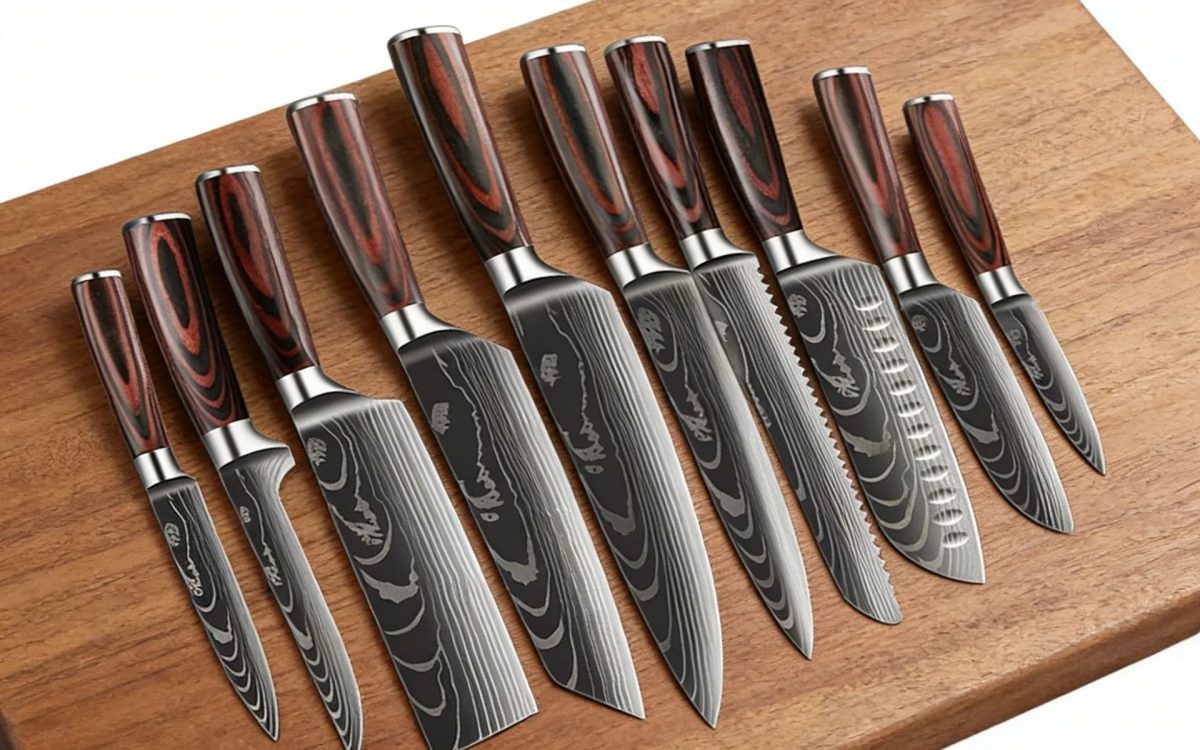
A new knife brand usually fails at the range, not at the knife. One good knife is not a range; a range that shares no components is not a business. The planning question is which knives to launch, in what order, and what they share.
This article sets out a range architecture that works for a new brand entering at low volume with limited budget, and explains the commercial logic behind each decision.
The three tiers of a range architecture
| Tier | Role | Typical share of SKUs | Typical share of revenue | Margin |
|---|---|---|---|---|
| Entry / appeal | Drives traffic, achieves the price point, gives buyers a reason to consider the brand | 40% | 25% | Lowest |
| Core / volume | Does the work: the pieces most buyers actually use daily | 40% | 60% | Highest volume, good margin |
| Hero / halo | Establishes credibility and quality perception, small volume | 20% | 15% | Best margin percentage |
A range made only of hero pieces has no traffic. A range made only of entry pieces has no margin. The mix is the strategy.
Launch sequence for a new brand
| Phase | SKU count | Composition | Purpose | Timing |
|---|---|---|---|---|
| Phase 1 — core quartet | 3–5 | Chef, paring, utility or santoku, bread, plus one hero | Credibility and a working kitchen | Launch |
| Phase 2 — completion | 4–6 | Fillet, carving, boning, slicing, a second size of chef | Fills the knife block, raises average order value | 3–6 months after launch |
| Phase 3 — sets and channel variants | 2–4 configs | Two-piece, three-piece, block set, gift box | Higher basket value, gift season | 6–12 months |
| Phase 4 — specialisation | 3–5 | Specialty Japanese shapes, long slicer, single-bevel | Enthusiast segment, PR value | 12+ months |
Launching twelve SKUs at once multiplies tooling, sampling, testing and packaging cost by twelve while the brand has no sales data to guide it. Launch small, learn, then extend.
Component sharing — the single biggest cost lever
| Shared element | Effect on cost | Effect on brand | Recommendation |
|---|---|---|---|
| Handle material and colour | Fewer materials, larger purchase volumes, one handle supplier | Strong visual family identity | Share aggressively |
| Bolster and ferrule | Avoids a second tooling set | Consistent transition | Share |
| Rivet pattern | Same fixture, same process | Immediate recognisability | Share |
| Blade steel grade | One material stream, one hardness target, one testing scope | Simplifies the brand story | Share across the core tier |
| Surface finish | One process line, one appearance standard | Family coherence | Share within a tier |
| Packaging structure | One structural die, different printed graphics | Recognisable shelf presence | Share |
| Blade shapes | Each new shape needs its own tooling | The reason customers buy more pieces | Vary — this is the product |
Design the range so that only the blade shape varies within a tier. Everything else — steel, hardness, finish, handle material, handle colour, bolster, rivets, pack structure — is fixed. A twelve-SKU range built this way has twelve tooling items; a naive twelve-SKU range can have thirty.
Pricing architecture
Build the range price ladder before approaching factories. Worked example, retail prices excluding tax:
| SKU | Retail | Target margin at retail | Max landed cost | Implied FOB ceiling |
|---|---|---|---|---|
| Paring, entry tier | €19 | 60% gross | €7.60 | ≈ €5.50–6.00 |
| Utility, entry tier | €24 | 60% | €9.60 | ≈ €7.00–7.60 |
| Chef 20 cm, core tier | €49 | 60% | €19.60 | ≈ €14.00–15.50 |
| Santoku 18 cm, core tier | €49 | 60% | €19.60 | ≈ €14.00–15.50 |
| Bread 21 cm, core tier | €45 | 60% | €18.00 | ≈ €13.00–14.50 |
| Chef 24 cm, hero tier | €99 | 62% | €37.60 | ≈ €27.00–31.00 |
| Two-piece set | €79 | 60% | €31.60 | ≈ €23.00–26.00 |
"Max landed cost" is the total cost of the knife on your shelf: FOB plus freight plus duty plus insurance plus any destination handling. The FOB ceiling is what remains after those are subtracted. Quote the factory from the FOB ceiling, not from a wish. See reading a quotation and cost breakdown.
Making the range feel like a family
Buyers decide in seconds whether a range looks designed or assembled. Consistency signals are cheap if planned and impossible to retrofit:
- One blade profile language: the same spine curvature and tip geometry across the range.
- One handle silhouette, scaled, not redesigned, for different blade lengths.
- One finish per tier.
- One logo position and size across every blade.
- One packaging structure with a colour-coded tier band.
What breaks family identity fastest is a range where the entry knife uses a stamped blade with a hollow grind and a moulded handle, and the hero knife uses a forged blade with a full flat grind and a riveted wood handle, with no visual bridge between them. If the tiers differ technically, connect them through shape and colour.
Range extensions that dilute versus extend
| Extension | Verdict | Reason |
|---|---|---|
| More blade lengths in the same family | Extends | Same tooling logic, same customer, higher basket |
| Two-piece and three-piece sets from existing SKUs | Extends | No new product, big basket increase |
| Gift box variant | Extends | New pack, not new tooling |
| Sharpening steel or honing rod | Usually extends | Adjacent, same customer, low complexity |
| Cutting board | Depends | Different material stream, different factory competence |
| Kitchen shears, peelers, gadgets | Dilutes | Different category, different quality expectations |
| Cast iron or cookware | Dilutes | Different everything |
| Entry-tier versions of hero SKUs | Risks | Cheapens the hero and cannibalises it |
Sizing the launch order
The first order has to be big enough to justify tooling and small enough to survive being wrong. A workable structure:
| SKU type | First order quantity | Rationale |
|---|---|---|
| Core volume SKU | 1,000–3,000 | Enough to amortise tooling and fill the channel |
| Second-tier SKU | 500–1,000 | Enough to test demand without overstocking |
| Hero SKU | 300–800 | Low volume by design |
| Set configuration | 200–500 | Made from existing SKU stock |
If the factory's minimum order quantity exceeds this for every SKU, that is a signal either to reduce the SKU count at launch or to accept shared existing shapes for the first phase. See orders below MOQ.
Planning checklist
- Define the tiers and the SKU count per tier before any design work.
- Fix every shared component in writing.
- Build the price ladder and derive the FOB ceiling per SKU.
- Confirm which blade shapes are genuinely new versus existing.
- Plan the launch order quantities by tier.
- Sequence the extensions and put dates against them.
- Write a one-page range document and attach it to every factory brief.
Related reading
Looking for a kitchen knife manufacturer?
We manufacture chef knives, knife sets, Damascus and steak knives in Yangjiang with OEM and private label service. Get a quote today.
Get Free Quote → Browse Products