Knife Forging: Hot Drop Forging, Hand Forging and Their Place in Cutlery Production
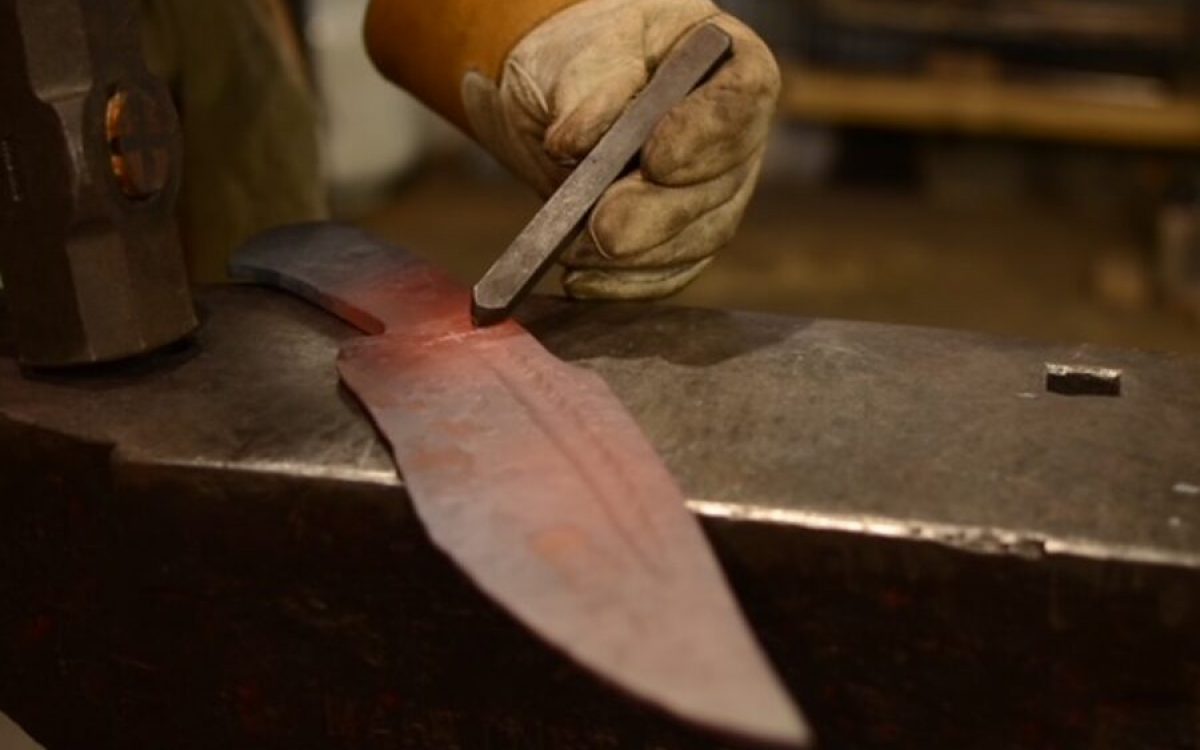
Forging is the oldest blade-making method and the strongest marketing claim in cutlery. It is also misunderstood on both sides: buyers are sold a story about density and strength, and factories are asked for forged blades when the design did not require them.
This article sets out what forging actually does metallurgically, what it costs, and when it is the right choice.
The forging routes
| Route | Process | Output | Tooling cost | Labour | Volume range |
|---|---|---|---|---|---|
| Hot drop forging | Heated billet struck in a closed die, usually in several blows | Near-net-shape blade with flash | High — one or more dies per shape | Moderate | Thousands and up |
| Hot upset / heading | Local forming to create a bolster or thick section | Blade with a forged bolster on a stamped blank | Moderate | Low | Thousands and up |
| Hand forging | Billet shaped by hammer and anvil, often with a power hammer | Individually formed blade | Very low | Very high | Tens to hundreds |
| Roll forging | Passed between shaped rolls to reduce section progressively | Blade with a tapered section | Moderate to high | Low | High volume |
| Cold forging / coining | Formed at room temperature in a die | Blade with surface detail and some section change | High | Low | High volume |
What forging actually does
| Claim | Reality | Nuance |
|---|---|---|
| "Forging makes the steel denser" | Cast and wrought steel of the same grade have essentially the same density | Forging closes internal porosity and breaks up segregation, which improves properties — but it does not "compress" the metal |
| "Forging aligns the grain flow" | True, and it matters at stress concentrations | Grain flow following the blade outline improves toughness at the tang and bolster transition |
| "Forged blades hold an edge longer" | Not directly | Edge retention follows hardness, carbide structure and geometry. A forged blade with the same hardness and geometry as a stamped blade performs the same at the edge |
| "Forged blades are stronger" | Generally true at the tang and bolster | The benefit is concentrated where the section changes. A uniform blade gains little |
| "A forged bolster means better balance" | True — the bolster is the balance mechanism | This is the strongest practical argument for forging in Western style knives |
| "Hand forged is better than drop forged" | Not necessarily | Hand forging offers shape freedom and craft value. Drop forging offers consistency. Consistency is worth more to a production buyer |
The honest summary: forging improves toughness and grain flow at transitions, enables an integral bolster that sets balance, and enables a genuine thickness taper. It does not improve edge retention, which is a function of hardness and geometry.
Where forging earns its cost
| Design feature | Requires forging? | Alternative | Value of forging here |
|---|---|---|---|
| Integrated forged bolster | Effectively yes | A separately fitted bolster, welded or pressed on | High — appearance, balance, no joint to fail |
| Distal taper in the blade section | Not required | Grinding a tapered section from flat stock | Moderate — forging gets there with less material waste |
| Full-size tang with a smooth spine-to-handle transition | Not required | Stamped full tang, ground transition | Low to moderate |
| Curved spine with mass at the heel | Not required | Ground from flat stock | Low |
| Hammered texture surface | Not required | Die-formed or ground texture | Aesthetic only |
| Heavy cleaver with a thick spine | Helpful | Thicker flat stock, more grinding | Moderate — material yield |
The integrated forged bolster is the feature that most justifies the cost. It is a solid continuation of the blade steel through the handle junction, it sets the balance point forward, and it eliminates the gap where a fitted bolster collects food residue. For a classic European style knife this is a genuine functional advantage, not marketing. See bolsters and handle attachment.
Cost reality
| Cost element | Stamped | Drop forged | Difference |
|---|---|---|---|
| Tooling | Moderate, one die | High, often multiple dies per shape | Significantly higher for forging |
| Material input per blade | Strip area times thickness | Billet volume plus flash loss | Flash is a real loss, commonly several percent to over ten percent |
| Heating energy | None for blanking | Substantial, furnace and fuel | Added for forging |
| Labour per piece | Low | Higher, including die handling and flash trimming | Added for forging |
| Grinding and finishing | More grinding to establish a bevel | Less grinding, near-net shape | Partly offsets |
| Scrap and rework | Lower | Higher, with flash and forming defects | Added for forging |
| Net unit cost at volume | Lower | Higher, typically by a meaningful margin | For the price position, this has to be justified by the product |
Forging is not a small premium. On a comparable knife it commonly adds a double-digit percentage to the factory cost, and the tooling is several times higher. A brand that specifies forging for a value price point has made an arithmetic error, not a quality decision.
The forge-and-grind workflow
| Step | Parameter | Risk |
|---|---|---|
| Billet cutting | Weight control per blade | Underweight leads to short fill; overweight wastes material and flashes |
| Heating | Temperature window and atmosphere | Overheating causes burning; too cool causes incomplete fill and cracking |
| Preform | Intermediate shape | Poor preform means the final die does not fill |
| Finish forging | Die temperature, blows, lubrication | Laps, folds and cold shuts — internal defects that only show after grinding |
| Trimming | Trim die condition | Tearing, bend, dimensional error |
| Normalising | Temperature and cooling | Skipping this leaves stress that distorts in hardening |
| Rough grinding | Stock removal to datum | Revealing forging defects after most of the cost is spent |
Cold shuts and laps are the forging-specific defect class: a fold where the metal did not weld to itself. They are invisible from outside and often only appear after grinding or in a destructive test. If you commission a forged product, ask what the forge's process control looks like and whether they perform a first-article destructive examination. This is a reasonable request and a revealing one.
Specification points for a forged blade
- Steel grade and the billet source.
- Forging temperature window.
- Number of blows or passes, if the forge records it.
- Flash allowance and trim specification.
- Section thickness at spine, mid-blade and near the tip — this is where the taper is defined.
- Bolster dimensions and whether the bolster is integral or attached.
- Normalising cycle before hardening.
- Straightness tolerance after heat treatment.
- Surface condition acceptance criteria, including any forged texture that is intended to remain visible.
- First-article destructive examination requirement.
When not to forge
- When the design has no integral bolster and no meaningful section taper. The gain is then small and the cost is real. - When the volume is below the point where the forging die amortises. - When the price point is value retail. - When lead time is tight, because forging adds furnace and die handling time.A stamped blade with an excellent heat treatment, a good grind and a well-made riveted handle will outperform a mediocre forged blade in use. The construction method is one input among several, and it is not the one the customer feels first. See stamped versus forged and steel metallurgy.
Related reading
Looking for a kitchen knife manufacturer?
We manufacture chef knives, knife sets, Damascus and steak knives in Yangjiang with OEM and private label service. Get a quote today.
Get Free Quote → Browse Products