Knife Stamping Lines: Dies, Tonnage, Throughput and What Sets Unit Cost
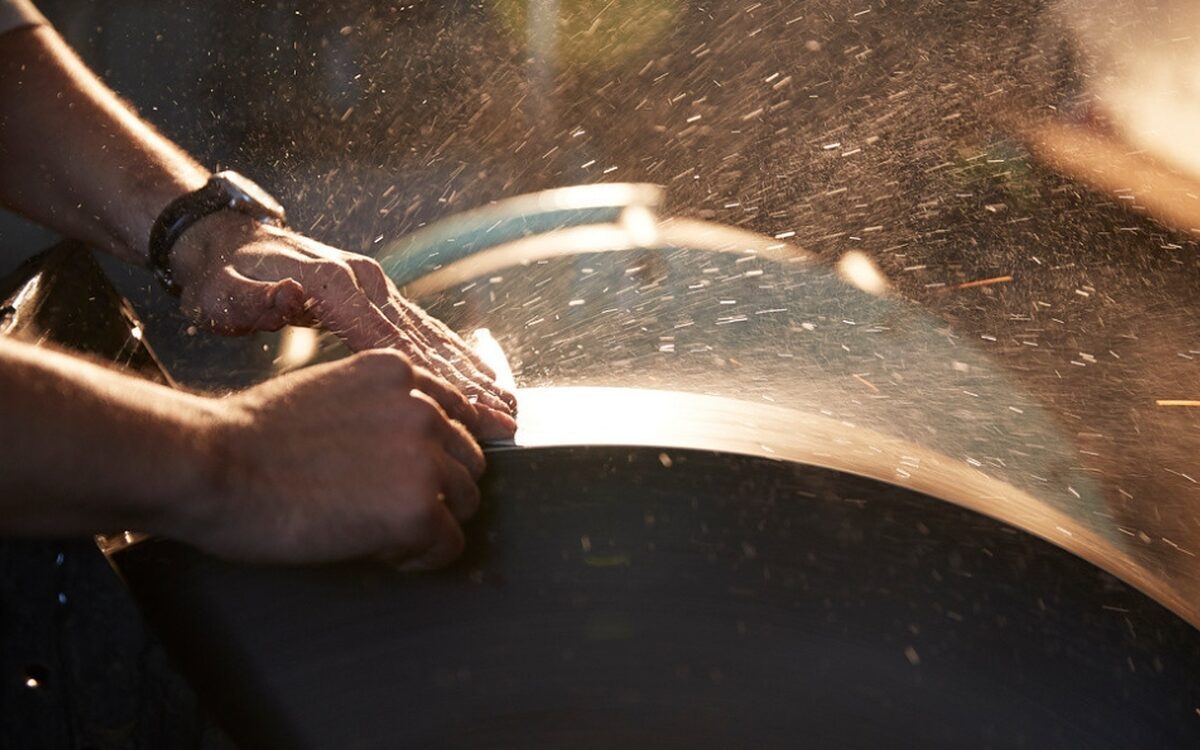
Stamping is how the overwhelming majority of kitchen knives are made. It is fast, it is cheap at volume, and it puts a hard ceiling on the shape and the thickness distribution a blade can have. Understanding the line is how a buyer knows what a quotation implies about the factory making it.
This article covers the press, the die, the tonnage calculation, throughput and how each of those shows up in the unit price.
What a stamping line is
| Element | Function | What it determines |
|---|---|---|
| Press frame and drive | Applies force to the die | Tonnage available, stroke rate, bed size |
| Die set | Cutting or forming the blade | Blade outline, tolerance, die life |
| Feeder | Advances strip into the die | Accuracy of pitch, material utilisation |
| Coil and straightener | Supplies flat strip | Flatness, surface condition |
| Scrap handling | Removes offcuts | Whether the line can run continuously |
| Coolant or lubrication | Reduces friction and heat | Die life, surface quality |
Tonnage — what it is and why it caps the design
Punching force is roughly the shear strength of the material multiplied by the cut perimeter multiplied by the thickness:
Force ≈ shear strength × perimeter × thickness
For stainless cutlery steel, shear strength is on the order of several hundred megapascals. A worked example for a 200 mm blade outline with a 2.5 mm thickness and a cut perimeter of roughly 500 mm:
| Parameter | Value |
|---|---|
| Cut perimeter | 500 mm |
| Thickness | 2.5 mm |
| Shear strength (assumed) | 450 MPa |
| Force | ≈ 562,500 N ≈ 563 kN ≈ 57 tonnes |
| Press selected with a safety factor of 1.5–2 | 90–120 tonnes |
Consequences for the buyer:
- A thicker blade needs a bigger press. If the factory's largest press is 100 tonnes, a design requiring 150 tonnes is not going to be made there without a new press or a subcontract.
- A longer blade with a longer perimeter needs more force. An unusually long slicer can be the most expensive blade in a range for reasons that have nothing to do with material.
- A larger blade needs a larger die and a larger bed. Bed size limits the maximum blade length physically.
Ask the factory for their maximum blade length and their press tonnage range. It is a one-line question that prevents a design that cannot be produced.
The die
| Die element | Purpose | Failure mode |
|---|---|---|
| Punch | Cuts the blade profile | Wear, chipping, edge rounding |
| Die block | Mates with the punch | Wear enlarging the clearance |
| Clearance | Gap between punch and die, typically a percentage of thickness | Too small: punch wear and cracking. Too large: heavy burr and poor edge quality |
| Stripper | Holds the strip and removes the part | Marking the surface, part distortion |
| Pilots and stops | Locate the strip precisely | Wear causing pitch drift |
| Springs or gas cylinders | Provide stripping force | Fatigue, loss of force over time |
Die life in cutlery is commonly expressed in tens of thousands to hundreds of thousands of strokes before refurbishment, depending on material, thickness, clearance and lubrication. A shape with tight internal radii and sharp corners wears a die faster and can crack it. This is the manufacturing reason behind the design advice to avoid sharp internal corners. See blade drawing development.
Throughput and what sets unit cost
| Factor | Effect on throughput | Effect on unit cost |
|---|---|---|
| Strokes per minute | Direct | High — labour is spread over more parts |
| Blanks per stroke | Direct multiplier | High — often the single biggest lever |
| Coil width and nesting | Determines blanks per stroke | High, via both material and rate |
| Die setup time between products | Reduces effective uptime | High at small batch sizes |
| Material changes and purge | Reduces uptime | Moderate |
| Downstream bottleneck | Press is idle when grinding cannot keep up | Moderate to high |
Blanks per stroke is the metric that most directly explains why a small knife can be cheaper than its steel content suggests and why a large one can be unexpectedly expensive. A die that yields two paring knives per stroke is doing twice the work of a die yielding one chef knife, on the same press at the same stroke rate.
Stamping versus alternative routes
| Route | Tooling cost | Unit cost at volume | Shape freedom | Thickness distribution | Best for |
|---|---|---|---|---|---|
| Stamping from strip | Moderate | Lowest | Limited to 2D outline plus grinding | Uniform, unless ground in | |
| Stamping plus cold forming | Moderate to high | Low | Some 3D features such as a bolster | Partly variable | |
| Hot drop forging | High | Moderate to high | Full 3D freedom including integrated bolster | Distal taper achievable | |
| Laser cutting from sheet | Very low | High for volume, low for small runs | Very high 2D freedom | Uniform | |
| Waterjet cutting | Very low | Higher than laser at thickness | Very high, no heat affected zone | Uniform | |
| Hand forging from bar | Low tooling | Very high labour | Maximum | Fully variable |
The practical decision rule: stamping for volume and conventional shapes, laser for prototyping and short runs of unusual shapes, forging when the design needs an integral bolster or a genuine distal taper. See stamped versus forged and laser versus waterjet.
Secondary operations after stamping
Blanking produces a flat outline. Almost every stamping line then performs one or more of these before the blade goes to heat treatment:
| Operation | Purpose | Cost effect |
|---|---|---|
| Coining / embossing | Raises a logo or a bolster shape in the flat | Extra station in the die |
| Piercing | Holes for rivets or a lanyard | Extra station, low cost |
| Trimming | Cleans the outline | Extra station |
| Bending or forming | Creates a bolster or a curved spine | Extra station, higher tooling |
| Deburring | Removes the burr before heat treatment | Labour or a tumbling step |
A progressive die does several of these in one pass, which is why a well-designed die reduces unit cost substantially at volume and why die cost rises with each added station. For a small first order, a simpler die with more manual handling is often the cheaper route end to end.
What to ask about a stamping line
- What is the press tonnage range and bed size?
- What is the maximum blade length you can blank?
- What strip width do you stock, and how many blanks per width for my shape?
- How many stations does my die need, and what does each add to the die cost?
- What is the projected die life before refurbishment for this material and thickness?
- Is there a counter on the die, and do you record strokes?
- What is the setup time between products, and how does that affect small-batch pricing?
- Where is the burr controlled, and what is the burr height specification?
Question seven explains most of the pricing difference between a 500-piece and a 5,000-piece order. Setup is a fixed cost that has to be divided by the quantity. See tooling economics and tooling amortisation.
The manufacturing constraint behind a design decision
Every time a brand asks for a blade that is 5 mm taller, 10 mm longer, or has a sharper heel corner, one of the four constraints moves: press tonnage, bed size, coil width, or die life. Involving the factory at the drawing stage is not a courtesy, it is how a design becomes manufacturable at the intended cost. A shape that is elegant on screen and expensive on the line is the most common avoidable cost in private label cutlery.
Related reading
Looking for a kitchen knife manufacturer?
We manufacture chef knives, knife sets, Damascus and steak knives in Yangjiang with OEM and private label service. Get a quote today.
Get Free Quote → Browse Products