Laser Cutting vs Waterjet for Knife Blanks: Speed, Edge Quality and Cost
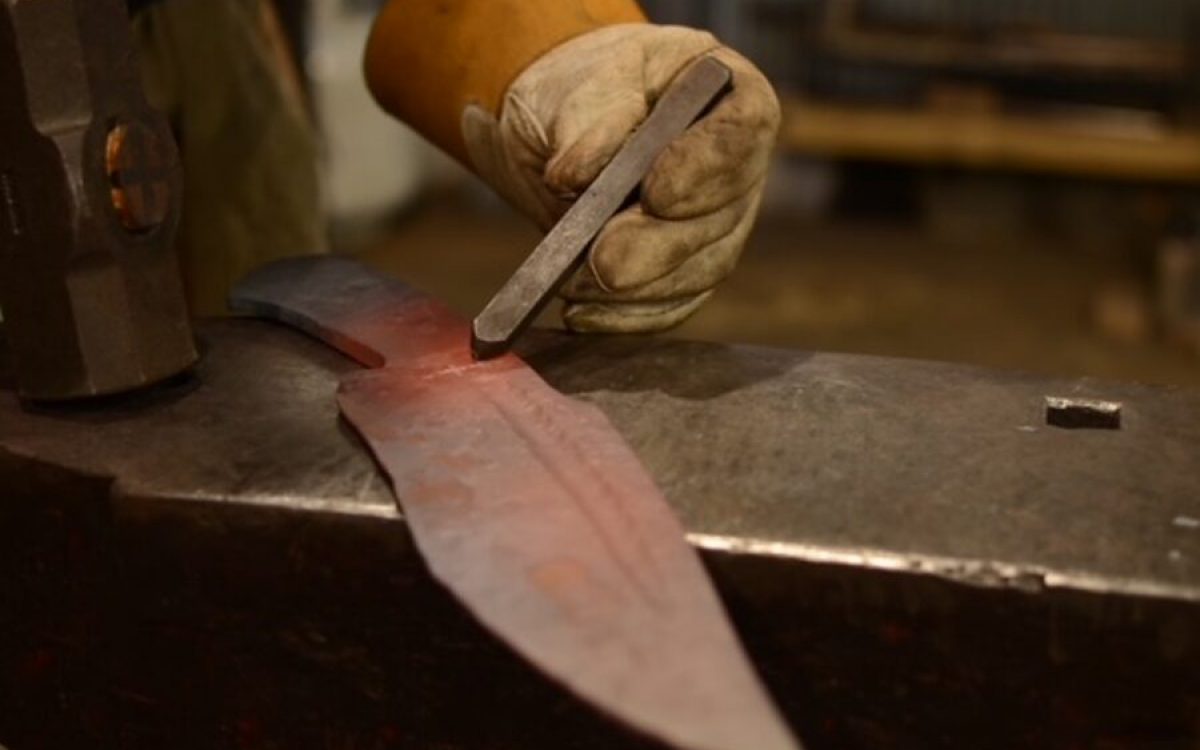
For prototyping, for short runs, and for shapes that will never justify a stamping die, laser and waterjet cutting are the two practical ways to get a blade blank from flat sheet. Choosing between them is a question of edge quality, heat effect, thickness, tolerance and cost.
This article compares them in production terms and explains when each is the right answer.
Comparison
| Factor | Laser cutting | Waterjet cutting |
|---|---|---|
| Cutting mechanism | Focused beam melts and vaporises; assist gas ejects | High-pressure abrasive slurry erodes |
| Heat affected zone | Yes, typically small but present; can be larger with a slow cut | None, effectively — the process is cold |
| Blanking edge | Clean, slightly heat-tinted; may show a small taper | Matte, slightly rougher; negligible taper with good control |
| Typical tolerance | Roughly ±0.1 mm on thin material with good fixturing | Roughly ±0.1 to ±0.2 mm, depending on thickness and machine |
| Cutting speed on thin steel | Fast | Slower |
| Speed on thick steel | Falls off sharply above a few millimetres | Maintains capability; slow but reliable |
| Practical thickness range | Best on thin sheet; drops off as thickness rises | No practical upper limit for knife work |
| Hardened material | Can cut hardened steel with more power, with more heat effect | Cuts hardened steel without thermal effect |
| Running cost | Power and assist gas | Abrasive consumption is the dominant cost |
| Kerf | Narrow | Wider — more material consumed per part |
| Health and safety | Beam and fume control | High-pressure water and abrasive handling |
| Post-processing needed | Usually deburr and sometimes remove oxide | Usually deburr |
The heat affected zone question
Laser cutting is a thermal process, and the cut edge is heated. On a knife blank the practical concerns are:
- Effect in the annealed state. If the blank will be hardened afterwards, the heat affected zone is erased by the subsequent austenitising treatment. The laser cut is then a non-issue metallurgically, and laser is usually the cheaper and faster option.
- Effect in the hardened state. If the laser cuts an already-hardened blade, the cut edge is locally softened or, worse, re-hardened and untempered. That is a brittle edge condition. It matters a great deal if the cut edge is near the cutting edge or the tip.
- Oxide on the cut face. Laser cutting leaves an oxide that can interfere with finishing, marking and any subsequent welding or adhesion. Deburring and pickling may be needed.
Waterjet has no heat effect at all, which is why it is the standard answer for cutting hardened blanks, for cutting near a finished edge, and for any material where a thermal effect is unacceptable.
Cost structure
| Cost component | Laser | Waterjet |
|---|---|---|
| Setup / programming | Low — digital file | Low — digital file |
| Tooling | None | None |
| Machine time | Lower on thin material | Higher |
| Consumables | Assist gas, optics | Abrasive, nozzle, pump parts |
| Material utilisation | Narrow kerf, better nesting | Wider kerf, slightly more material lost |
| Post-processing | Deburr, maybe oxide removal | Deburr |
| Net cost at thin gauge, large quantity | Usually lower | Usually higher |
| Net cost at heavy gauge or hardened material | Rises sharply | Higher absolute cost but often the only practical option |
The decision cross-over is usually thickness-related:
| Blade thickness | Condition | Preferred process | Reason |
|---|---|---|---|
| Under 2 mm | Annealed | Laser | Fast and cheap, no metallurgical consequence |
| 2–4 mm | Annealed | Either; laser usually wins on cost | Both are adequate; compare quotes |
| Over 4 mm | Annealed | Waterjet | Laser speed and edge quality deteriorate |
| Any thickness | Hardened | Waterjet | No thermal effect |
| Any thickness | Near a finished edge or tip | Waterjet | Avoid a softened or brittle zone at the functional feature |
When cutting is better than a die
| Situation | Cutting | Stamping die |
|---|---|---|
| Prototype, 1–20 pieces | Clearly better | Die cost unjustifiable |
| Sample rounds for a buyer | Better | Premature |
| Trial order of a few hundred | Often better end to end | Die amortisation per unit is high |
| Shape still being iterated | Clearly better — no tooling to re-cut | Every change means die modification |
| Volume production, stable shape | Unit cost too high | Clearly better |
| Very large or unusual outline | Possible | Press bed and tonnage may rule it out |
| Very small parts, nested tightly | Possible but slow | Clearly better |
The commercial insight is that cutting lets a brand delay tooling spend until the design is proven. For a first private label project with an uncertain market, cutting the first few hundred pieces and stamping later is often the lower-risk route, even though the per-piece cost is higher. See tooling amortisation.
Design considerations specific to cutting
- Kerf compensation. The cut path removes material, so the drawing must be offset by half the kerf. This is the cutter's job but the buyer should confirm it is done.
- Hole sizes. A rivet hole should not be smaller than roughly the material thickness for a clean cut. Very small holes are slow and imprecise.
- Nesting. Both processes benefit from nesting, but laser's narrower kerf packs more parts per sheet. For a long, narrow blade the nesting plan can change the material cost materially.
- Lead-in and lead-out. The cut has entry and exit points; on a laser these can leave a small mark. Place them away from visible faces and from the edge.
- Slot width. Narrow slots in a blade, for example for a decorative cut-out, are limited by kerf. A slot narrower than roughly the kerf plus a tolerance cannot be produced.
- Tab and support. Thin long parts can distort or move during cutting. The nest design must support the part, sometimes with small tabs that are removed afterwards.
Specification points
- Process named explicitly, with a rule for which thickness triggers which process.
- Tolerance for the outline.
- Kerf compensation confirmed.
- Heat affected zone: acceptable or not, and if acceptable, what maximum depth.
- Burr height limit and the deburring method.
- Surface condition after cutting, including whether oxide removal is required.
- Nesting plan and blanks per sheet.
- If the material is hardened before cutting, the maximum temperature rise allowed at the cut edge and the hardness verification method at a defined distance from the cut.
Practical recommendation
For a new blade shape, cut three to five pieces by laser from annealed stock to validate the geometry in the hand. Once the shape is fixed, use laser cutting for the pilot run of a few hundred if the material is annealed and thin, or waterjet if the section is heavy. Move to a stamping die when the volume justifies it and the shape stops changing. The one thing to avoid is cutting a hardened blade with a laser near the tip or the edge. It is the cheapest route on paper and it produces a knife with a hidden brittle zone exactly where failures happen. See heat treatment and stamping.Related reading
Looking for a kitchen knife manufacturer?
We manufacture chef knives, knife sets, Damascus and steak knives in Yangjiang with OEM and private label service. Get a quote today.
Get Free Quote → Browse Products