Injection Moulded and Overmoulded Knife Handles: Tooling, Materials and Bonding
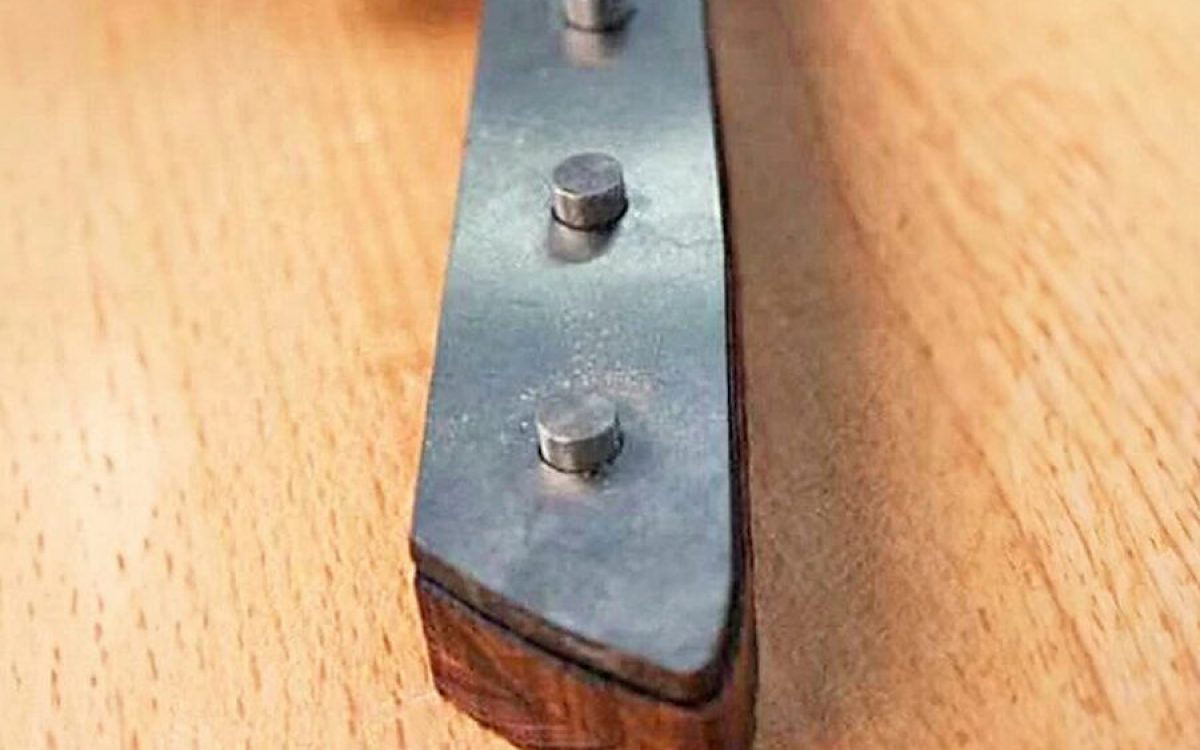
Moulded handles make the cheapest high-volume kitchen knives possible and the worst cheap kitchen knives possible. The difference is entirely in the tooling, the material choice and the process control — none of which is visible in the finished product until it fails.
This article covers injection moulding and overmoulding in cutlery, the tooling economics, and what to specify.
Injection moulding versus overmoulding
| Process | What happens | Result | Tooling | Unit cost |
|---|---|---|---|---|
| Single-shot injection moulding | One material injected into a cavity around an insert tang | Uniform handle in one material | One mould | Lowest |
| Two-shot injection moulding | Two materials injected sequentially in the same machine, without removing the part | Hard core with a soft grip, chemically or mechanically bonded | One complex mould with two cavities and a rotating or sliding element | Low at volume, high tooling |
| Overmoulding | A pre-moulded hard part is placed in a second mould and a soft material injected over it | Hard substrate with a soft grip layer | Two moulds plus a placement step | Low to moderate |
| Insert moulding | The metal tang is placed in the mould as an insert | Handle bonded mechanically to the tang | One mould plus loading fixtures | Low |
| Co-injection or sandwich moulding | Two materials injected as a core and skin | Recycled core with a virgin skin | Special machine and mould | Moderate |
Materials
| Material | Character | Dishwasher | Grip when wet | Cost | Notes |
|---|---|---|---|---|---|
| Polypropylene (PP) | Tough, slightly waxy, flexible | Excellent | Moderate | Low | Highly recyclable, common |
| ABS | Rigid, good surface finish, can be glossy | Good | Poor | Low | Good appearance, can look plasticky |
| Acetal (POM) | Hard, low friction, dimensionally stable | Good | Poor | Moderate | Used for hard components and some handles |
| Nylon (PA) | Tough, absorbs moisture, dimensionally variable | Moderate | Moderate | Moderate | Moisture absorption can change dimensions |
| TPE / TPR (soft grip) | Rubbery, soft | Good to excellent depending on grade | Very good | Moderate | The standard soft-grip overmould material |
| TPU | Tough rubbery, abrasion resistant | Good | Very good | Moderate to high | Better wear than TPE |
| Silicone | Very soft, heat resistant | Excellent | Very good | High | Rarely used as a handle body; sometimes as a grip element |
| Glass-filled PA or PP | Stiffer, harder, less ductile | Good | Poor | Moderate | Stiffness where needed |
| Recycled PP or bio-based grades | Varies widely | Depends | Depends | Low to moderate | Requires material evidence to support a claim |
Two material decisions matter most. First, whether the handle is dishwasher-safe at all: this eliminates some grades immediately. Second, whether a soft grip is used, because a soft grip adds wear, peel and cleaning concerns in exchange for a better wet hold. For professional and dishwasher-heavy channels, a well-textured single-material handle is often the better engineering answer than a soft grip.
Mould design in cutlery
| Mould element | Effect on the product | Cost driver |
|---|---|---|
| Number of cavities | Throughput, and consistency across cavities | Roughly proportional to cavity count |
| Runner system | Waste and fill quality; a hot runner reduces scrap | Hot runners are significantly more expensive |
| Cooling channels | Cycle time and shrinkage control | Conformal cooling costs more, moulds faster |
| Parting line location | Whether a visible seam falls on a grip surface | Design effort |
| Ejection | Whether the part is marked or distorted on removal | More complex ejection, more cost |
| Insert location features | Whether the tang sits centrally and repeatably | Fixture design |
| Surface texture | Grip and appearance, from a polished cavity or a textured one | Texture is added by etching the cavity |
| Gate location | Weld lines and cosmetic defects | Simulation and iteration |
Parting line and gate location are where cheap handles announce themselves. A part line running across the finger contact area, or a visible gate scar on the side of the handle, reads as low quality to a buyer even if they cannot name the cause. Both are avoidable at the design stage and expensive to fix afterwards, because a mould has to be modified or replaced.
Insert moulding around a tang
| Requirement | Why | Typical specification |
|---|---|---|
| Tang section sufficiently large | Load bearing and grip against rotation | A defined minimum width and thickness |
| Mechanical interlock features on the tang | Prevents the handle pulling off or rotating | Holes, notches or a widened section |
| Tang surface condition | Adhesion to the polymer | Clean, degreased, and either roughened or coated as specified |
| Tang centring in the mould | Symmetry and wall thickness consistency | Fixture design; a stated positional tolerance |
| Tang temperature at moulding | Affects shrinkage and bond | Operator instruction or oven preheat |
| Wall thickness around the tang | Shrinkage voids and sink marks | A minimum wall thickness, typically several millimetres |
The mechanical interlock is the point where cheap handles fail. A tang that is a smooth, straight rod relies on adhesion alone, which is why rat-tail handles rotate and detach. Holes or notches in the tang let the polymer flow through and form a mechanical key. This is free to design in and impossible to add later. See tang and attachment methods.
Defects and their causes
| Defect | Cause | Effect | Control |
|---|---|---|---|
| Short shot | Insufficient fill pressure, low temperature, poor venting | Incomplete handle, scrap | Process window control, venting design |
| Sink marks | Thick sections cooling unevenly | Visible depression, poor appearance | Uniform wall thickness, adequate packing |
| Weld lines | Two flow fronts meeting | A visible weakness line and cosmetic defect | Gate location and flow simulation |
| Flash | Mould parting faces not tight, excess pressure | Finishing labour or a visible seam | Mould maintenance |
| Burn marks | Trapped gas igniting from compression | Discoloured patches | Venting |
| Delamination of soft overmould | Poor material compatibility, contamination, cold joint | Peeling grip, a hygiene trap | Material pairing validated, cleanliness, mould temperature control |
| Colour variation between batches | Masterbatch dosing, regrind content variation | Range that does not match | Regrind percentage limit, colour measured against a standard |
| Warpage | Uneven cooling, fibre orientation in filled grades | Handle does not sit straight | Cooling design, gate location |
Regrind content is the hidden variable that causes most colour and property variation. Most factories use a proportion of regrind, which is normal and reasonable, but the percentage should be capped and stated. A handle that varies visibly in colour from one shipment to the next is almost always a regrind content issue or a masterbatch dosing issue, and it is entirely controllable.
Tooling economics
| Mould type | Indicative tooling cost tier | Economic volume | Notes |
|---|---|---|---|
| Simple single-cavity prototype mould | Low | Tens to hundreds | Aluminium or soft steel, short life; useful for form and feel trials |
| Production single-cavity, hardened steel | Low to moderate | Thousands to tens of thousands | Long life, lower throughput |
| Multi-cavity production mould | Moderate to high | Tens of thousands and up | Throughput per cycle scales with cavity count |
| Two-shot mould | High | High volume | Complex, expensive, only justified for large programmes |
| Overmould tooling set | Moderate to high | Moderate to high | Two moulds plus a placement process |
For a first private label order of a few thousand pieces, a simple hardened single-cavity mould plus a modest cycle time is usually the right answer. A multi-cavity mould only pays back when the volume is large or when the handle will be shared across several SKUs — which is exactly why handle standardisation is the biggest cost lever in range planning. See range planning and tooling amortisation.
Specification points
- Material for each component, with a named grade and the colour reference.
- Regrind percentage limit.
- Whether the handle is single-material or overmoulded, and the soft material grade.
- Tang interlock features, with dimensions on a drawing.
- Surface texture or finish on the grip area.
- Parting line location, and the requirement that it not fall on a primary grip surface.
- Wall thickness specification and sink mark acceptance.
- Dishwasher exposure expectation, and a qualification test if the product claims dishwasher safety.
- Adhesion test for any overmoulded layer, with a pass criterion.
- Golden sample retained by both parties.
Related reading
Looking for a kitchen knife manufacturer?
We manufacture chef knives, knife sets, Damascus and steak knives in Yangjiang with OEM and private label service. Get a quote today.
Get Free Quote → Browse Products