The Kitchen Knife Manufacturing Process: From Steel Coil to Packed Finished Goods
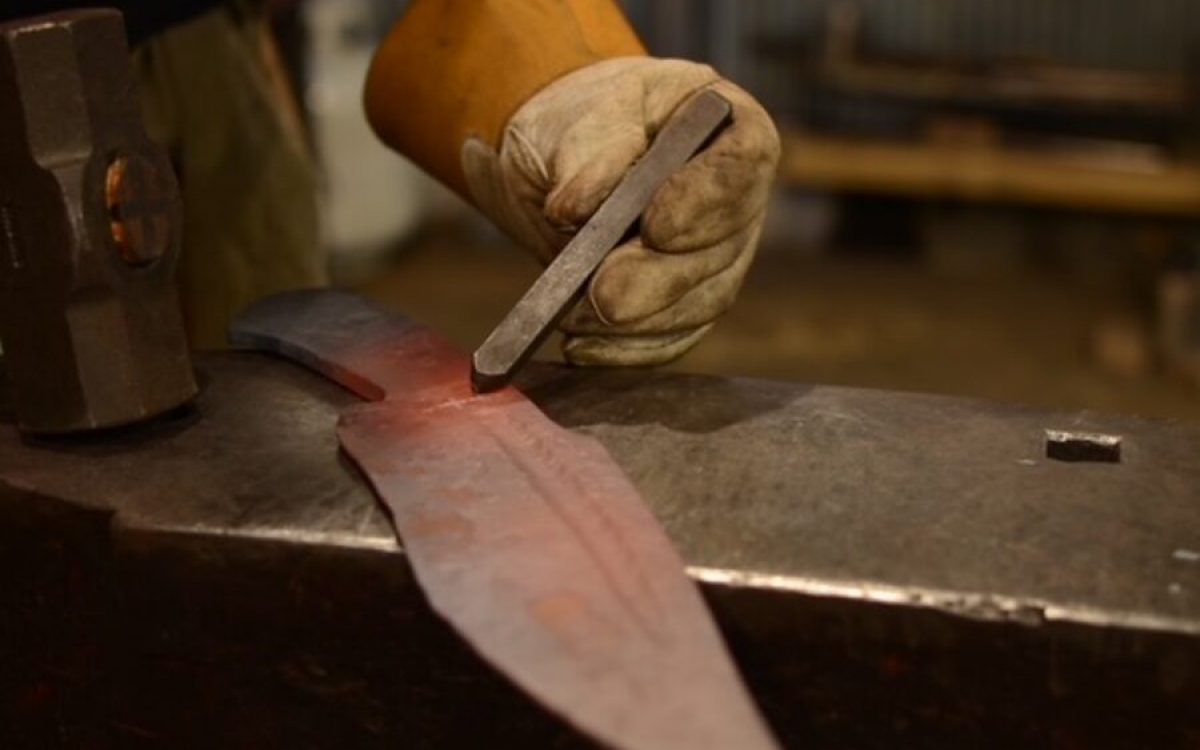
Understanding the production route does two things for a buyer: it explains where cost and lead time come from, and it tells you which questions to ask at which stage. A knife is roughly twenty process steps, and any of them can be the reason a shipment is late or wrong.
This is the full route from steel coil to packed finished goods, with the decision point and the risk at each stage.
The route
| # | Stage | What happens | Key parameter | Main risk |
|---|---|---|---|---|
| 1 | Steel incoming inspection | Coil or sheet received and verified against the mill certificate | Composition, thickness tolerance, hardness | Wrong grade or thickness entering production |
| 2 | Slitting / shearing | Coil cut to the strip width and length the die needs | Width tolerance, burr, flatness | Burr causing die damage; width error wasting material |
| 3 | Blanking | Blade blanks punched or laser cut from strip | Die clearance, tonnage, cycle rate | Die wear producing dimension drift |
| 4 | Annealing (if required) | Softens the blank for forming | Temperature, atmosphere, cooling rate | Decarburisation; scale; wrong hardness |
| 5 | Forming / forging (if required) | Blank shaped, bolster formed, thickness distribution set | Temperature, die condition | Dimensional variation; flash; lap defects |
| 6 | Trimming | Flash and edge cleaned | Trim die condition | Tearing; dimensional error |
| 7 | Normalising / stress relief | Removes forming stress before hardening | Temperature and cycle | Skipped step, leading to distortion in hardening |
| 8 | Rough grinding | Blade profile and bevel roughly established | Wheel grade, coolant, depth of cut | Overheating; grinding cracks |
| 9 | Hardening: austenitise | Heated to solution temperature | Temperature, soak, atmosphere | Grain growth; decarburisation |
| 10 | Quench | Rapid cooling to form martensite | Medium, agitation, section control | Distortion, quench cracks, soft spots |
| 11 | Cryogenic treatment (if used) | Hold well below zero to convert retained austenite | Temperature and hold time | Benefit not realised if the cycle is too short |
| 12 | Tempering | Reheat to relieve stress and set final hardness | Temperature and time, one or two cycles | Under-tempering leaves brittleness; over-tempering loses hardness |
| 13 | Hardness testing | Sample measurement | Location, method, sample size | Testing the wrong location, giving a false assurance |
| 14 | Straightening | Corrects distortion from hardening | Technique, temperature | Cracking; not fully correcting |
| 15 | Fine grinding | Bevel ground to final geometry | Coolant, wheel, feed rate | Edge overheating and softening — the classic hidden defect |
| 16 | Surface finishing | Brushed, blasted, satin or polished | Grit sequence, direction | Inconsistent appearance across a batch |
| 17 | Marking | Logo applied | Process, depth, location | Marking too close to the edge; removal by later polishing |
| 18 | Handle manufacture | Scales cut and finished, or plastic moulded | Material batch, mould condition | Colour variation between batches |
| 19 | Assembly | Handle attached, riveted or bonded; bolster fitted | Fixturing, adhesive, rivet torque | Misalignment; weak joints; visible gaps |
| 20 | Final sharpening | Edge set at the specified angle | Angle, grit, burr removal | Inconsistent angles; residual burr |
| 21 | Cleaning | Debris, oil, grinding residue removed | Wash chemistry, drying | Residue causing staining; trapped moisture |
| 22 | Final inspection | Visual and dimensional check against the standard | AQL plan, defect classes | Standard applied loosely or not at all |
| 23 | Packing | Retail pack and outer carton | Pack specification, carton count | Packing without an edge guard causing damage |
| 24 | Carton sealing and palletising | Outer cartons closed and stacked | Pallet pattern, compression strength | Crushed bottom cartons in transit |
Which stages dominate cost
| Cost category | Share of factory cost (indicative) | Driven by |
|---|---|---|
| Steel material | 20–35% | Grade, blade size, blanking yield |
| Blanking and forming | 8–15% | Die cost amortisation, cycle rate |
| Heat treatment | 5–12% | Route, equipment, batch size |
| Grinding and finishing | 20–35% | Labour intensity, finish specification |
| Handle and assembly | 10–20% | Material, construction type, labour |
| Inspection and packing | 5–12% | Pack complexity, AQL level |
| Overhead and margin | 10–20% | Factory efficiency and scale |
Grinding and finishing are the single largest controllable block for most products, and they are the first thing squeezed when a factory needs to meet a target price. A quotation that is well below the market is almost always cheaper in finishing labour rather than in materials. That is where the difference in appearance comes from. See grinding and polishing.
Yield and where material is lost
| Loss point | Typical loss | How it is recovered |
|---|---|---|
| Nesting of blanks in the coil | 10–25% of strip | Nest two shapes; design blade height to suit the standard coil width |
| Blanking scrap | Small, plus die setup pieces | Long runs; correct die clearance |
| Heat treatment distortion and scrap | 1–5% | Correct fixturing, straightening capability |
| Grinding scrap, especially at the tip | 1–4% | Trained operators, controlled feed rates |
| Handle fit rejections | 1–3% | Fixture quality, tolerance control |
| Final inspection rejections | 1–5% for a tight AQL | Nothing — this is the cost of quality |
Nesting yield is the item buyers never ask about and it is worth 10 to 25% of steel cost. A blade height chosen without reference to the standard coil width can waste a quarter of the material. Ask the factory what coil width they use for your blade and how many blanks per width. A 5 mm change in maximum blade height can change the nesting count materially.
In-process quality gates
| Gate | Checks | If skipped |
|---|---|---|
| Incoming material | Certificate match, thickness, hardness, visual | An entire batch produced from wrong material |
| After blanking | Dimensional, burr, die wear markers | Hundreds of out-of-tolerance blanks |
| After hardening | Hardness, straightness, surface condition | Undertempered blades reaching assembly |
| After fine grinding | Bevel geometry, edge angle, no overheating marks | Soft edges shipped as hard |
| After assembly | Handle alignment, gap, rivet integrity, marking position | Cosmetic rejects at final inspection, when it is too late |
| Before packing | Edge angle, burr, cleanliness, function | Customer complaints on sharpness |
The economics are straightforward. Every gate costs a little and saves a great deal. A factory with no in-process gates is not saving money, it is moving the cost from inspection to scrap and returns. Ask where the gates are and what the recorded results look like. See in-process quality control.
Lead time anatomy
| Phase | Typical duration | Controllable by the buyer? |
|---|---|---|
| Material procurement | 1–4 weeks | Partly — the factory may hold common grades in stock |
| Die and fixture preparation | 1–4 weeks | No, once ordered |
| Sample production | 1–2 weeks | Partly |
| Bulk blanking and forming | 3–7 days | No |
| Heat treatment, outsourced or in-house | 3–10 days | No; batches may queue |
| Grinding and finishing | 1–3 weeks | Partly — finish specification drives this |
| Assembly and packing | 3–7 days | No |
| On-site inspection | 1–3 days | Buyer controls the timing if using a third party |
| Inland transport and port handling | 3–7 days | No |
The outsourced heat treatment step is the most common source of unexpected delay. If a factory does not own its furnaces, your blades join another customer's queue. Ask whether heat treatment is in-house, and if not, expect the lead time to include a queue. See lead time management.
What the buyer can influence
| Lever | Effect on cost | Effect on lead time | Effect on quality |
|---|---|---|---|
| Blade height measured against coil width | High — material yield | None | None |
| Handle standardisation across SKUs | High — tooling and setup | Reduced | Improved consistency |
| Finish specification | Moderate to high | Moderate | Appearance and corrosion |
| Edge angle and geometry | Low | Low | High — this is the product experience |
| AQL level | Moderate | Low | Direct — sets the defect tolerance |
| Pack specification | Moderate | Moderate, if a new structure | Protection and retail presentation |
| Order quantity and batch pattern | High | High | Indirect, via stability |
Checklist for a new production run
- Confirm the mill certificate for the batch and reconcile it with the specified grade.
- Confirm the nesting plan and blanks per coil width.
- Confirm whether heat treatment is in-house and what the queue looks like.
- Agree hardness test location, method and sample size in writing.
- Confirm the operation sequence, especially marking relative to finishing and sharpening.
- Agree the in-process gates and the records to be kept.
- Agree the final inspection standard and AQL before production, not after.
Related reading
Looking for a kitchen knife manufacturer?
We manufacture chef knives, knife sets, Damascus and steak knives in Yangjiang with OEM and private label service. Get a quote today.
Get Free Quote → Browse Products