Knife Tooling and Dies: Manufacture, Life and Maintenance Economics
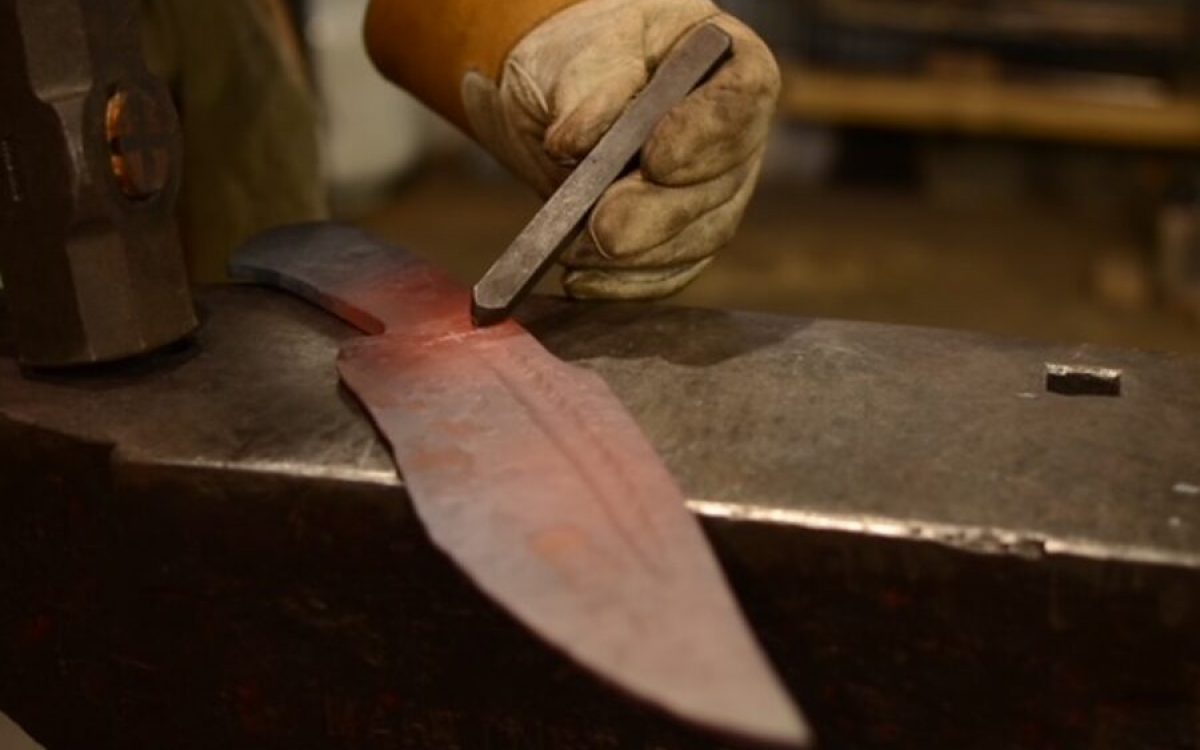
Tooling is the capital that turns a design into a product and the asset most likely to be poorly managed. A die is a precision instrument that produces thousands of parts; the same die in a badly run factory produces a drifting tolerance and, eventually, a batch of knives that do not match the sample.
This article covers die manufacture, life, maintenance and the commercial question of who owns and pays for tooling.
What tooling a knife project may need
| Tool | Purpose | Typical cost tier | Life character | Reusable |
|---|---|---|---|---|
| Blade blanking die | Cuts the blade outline | Moderate | Tens of thousands to hundreds of thousands of strokes with refurbishment | Only for that shape |
| Piercing and forming die | Holes, bolster forming, coining | Moderate to high | Similar to blanking, lower where forming forces are low | Partly |
| Forging die set | Shapes the blade in hot forging | High | Shorter than a blanking die because of thermal cycling | Only for that shape |
| Handle mould | Injection moulding the handle | Moderate to high | Hundreds of thousands of cycles in hardened steel | Yes, across blade shapes with the same handle |
| Overmould tool | Second shot for a soft grip | High | Similar to a mould | Yes |
| Grinding fixture or jig | Holds the blade at the correct angle | Low to moderate | Wears gradually; needs periodic re-mastering | Yes, across similar shapes |
| Marking fixture | Positions the logo | Low | Long, with periodic verification | Yes |
| Etching stencil | Chemical marking | Very low | Consumable | Per design |
| Pack structural die | Cuts and creases the carton | Low to moderate | Long | Yes, across products sharing the pack |
| Pack print plates | Printing the artwork | Low to moderate | Long, unless artwork changes | Only while artwork is unchanged |
| Insert mould or cut die | Tray or insert | Low to moderate | Long | Yes |
| Assembly jigs | Alignment during assembly | Low | Wears; needs periodic check | Yes |
How a blanking die is made
| Step | What happens | Quality point |
|---|---|---|
| Design from the production drawing | The die is designed from the blade drawing, compensated for clearance and material springback | Any error here propagates to every part ever made |
| Material selection for punch and die block | Tool steel chosen for wear resistance and toughness | Inadequate grade shortens life sharply |
| Machining | Rough machining of the profiles | Dimensional accuracy, surface finish |
| Heat treatment of the die components | Hardened and tempered to a specified hardness | Hardness of the punch and die; distortion control |
| Grinding | Precision grinding to final dimensions | Flatness, parallelism, clearance |
| Wire EDM or milling of the profile | Cutting the blade profile into the die block | Profile accuracy and surface finish |
| Fitting and assembly | Punch, die block, stripper, pilots assembled | Clearance consistency around the profile |
| Trial on the press | Test strokes with production material | Burr height, part dimensions, ejection |
| Adjustment | Clearance and profile adjusted | Iteration until the part is in tolerance |
| First article approval | Parts measured against the drawing | Documented approval |
The die trial and adjustment step is where the real cost sits and where supplier quality shows. A well-made die needs one or two adjustments; a poorly made die needs many, and the iteration consumes the buyer's schedule without appearing in the quotation.
Clearance — the parameter that governs die quality
| Clearance | Effect on the cut edge | Effect on the die | Effect on part quality |
|---|---|---|---|
| Too small | Secondary shear, rough and work-hardened edge | Accelerated punch wear, risk of punch chipping or fracture | Burr on one side, poor edge quality |
| Correct | Clean shear with a small controlled burr | Normal wear life | Consistent dimensions |
| Too large | Tearing and heavy burr | Die block wear, part pulled into the die | Dimensional variation, large burr requiring extra deburring |
Correct clearance is usually expressed as a percentage of material thickness, with the exact value depending on the material. For stainless cutlery steel it is typically in the mid single digits to low double digits as a percentage. A buyer does not need to compute it, but should require that the die is trialled on production material — not on a softer substitute — and that the resulting burr height is measured. A diemaker who trials on mild steel and then runs stainless will produce a different result.
Die life and maintenance
| Factor | Effect on die life |
|---|---|
| Material grade and thickness | Harder and thicker material reduces life roughly in proportion |
| Clearance correctness | Incorrect clearance can halve life |
| Lubrication | Good lubrication markedly extends life and improves edge quality |
| Die material and hardness | The primary determinant |
| Sharp corners and tight radii in the profile | Stress concentrations that cause cracking |
| Press condition and alignment | A misaligned press destroys a die quickly |
| Strokes per hour | Higher speed increases wear rate, and heat |
| Maintenance frequency | Regular light refurbishment greatly extends total life |
| Maintenance activity | Frequency | What it prevents |
|---|---|---|
| Visual inspection of the cutting edge | Each shift or daily | Running a chipped punch until it damages the die block |
| Burr height check | Per run, at intervals | Silent drift of clearance |
| Part dimension check against a master | At defined intervals | Gradual dimensional drift |
| Lubrication check | Per shift | Accelerated wear |
| Punch sharpening or replacement | Based on burr and edge condition, tracked by strokes | Poor edge quality and die damage |
| Die block refurbishment | At planned intervals | Clearance growth and part quality loss |
| Full die strip and inspection | Annually or at a stroke threshold | Hidden cracks and fatigue |
The single most useful control is a stroke counter on the press with a recorded maintenance threshold. Without a counter, maintenance is reactive and happens after quality has already drifted. With a counter, maintenance is planned and the quality distribution stays tight. Ask if the press has a counter and if the counts are recorded. See stamping lines and in-process quality control.
Ownership, payment and the awkward questions
| Question | Why it matters | What to put in writing |
|---|---|---|
| Who pays for the tooling? | Determines the upfront cash requirement and who carries the risk | A named line item, or an explicit statement that it is included and why |
| Who owns it? | Determines whether it can be moved or reused | An ownership clause plus an asset schedule with identifying marks |
| Is the cost amortised in the unit price? | Determines when the loading ends | The amortisation volume and the point at which the loading stops |
| Can it be transferred to another factory? | Determines the switching cost later | Realistically often difficult; get the drawings instead |
| What is the condition and the life consumed? | Affects the next order | A recorded stroke count or an inspection at handover |
| What happens on termination? | Determines who keeps the asset | A stated outcome: transfer, sale at an agreed value, or destruction |
The honest position on transferability: moving a die between factories is often technically difficult because press beds, shut heights and mounting patterns differ. What is genuinely transferable is the design — the drawings and native files. A brand that owns the drawings can have a new die made anywhere, which is the commercially meaningful form of ownership. Prioritise the drawings over the die. See design and IP ownership and tooling amortisation.
Tooling as a reusable asset
| Tool | Reuse potential | How to exploit it |
|---|---|---|
| Handle mould | High — one handle can serve many blade shapes | Standardise the handle across the range |
| Pack structural die | High — one pack across many products | Design a family pack from the start |
| Marking fixture | High | Use the same marking position on every blade |
| Grinding fixtures | Moderate — similar shapes can share | Keep blade angles consistent across the range |
| Blade die | None for other shapes | Only reuse by keeping the blade in the range long term |
| Print plates | Only while the artwork is unchanged | Batch artwork changes to avoid repeated re-plating |
The reuse column is the arithmetic behind range planning. A range of eight knives with one shared handle and one shared pack structure needs eight blade dies and one handle mould. The same range designed with a different handle for each knife needs eight moulds. That difference can be an order of magnitude in one-off cost. See range planning.
Specification points for tooling
- Tooling list with a description of each item and its cost.
- Ownership statement per item.
- Whether the cost is amortised, over what volume, and when it stops.
- Die material and hardness, if the buyer is paying.
- Required trial on production material, with measured results.
- First article approval against the drawing.
- Stroke counter and maintenance threshold requirements.
- Maintenance and refurbishment responsibility.
- Condition assessment at handover and on termination.
- Delivery of the drawings and native files as a condition of payment.
Related reading
Looking for a kitchen knife manufacturer?
We manufacture chef knives, knife sets, Damascus and steak knives in Yangjiang with OEM and private label service. Get a quote today.
Get Free Quote → Browse Products