San-Mai and Clad Kitchen Knives: How Three-Layer Blade Construction Works
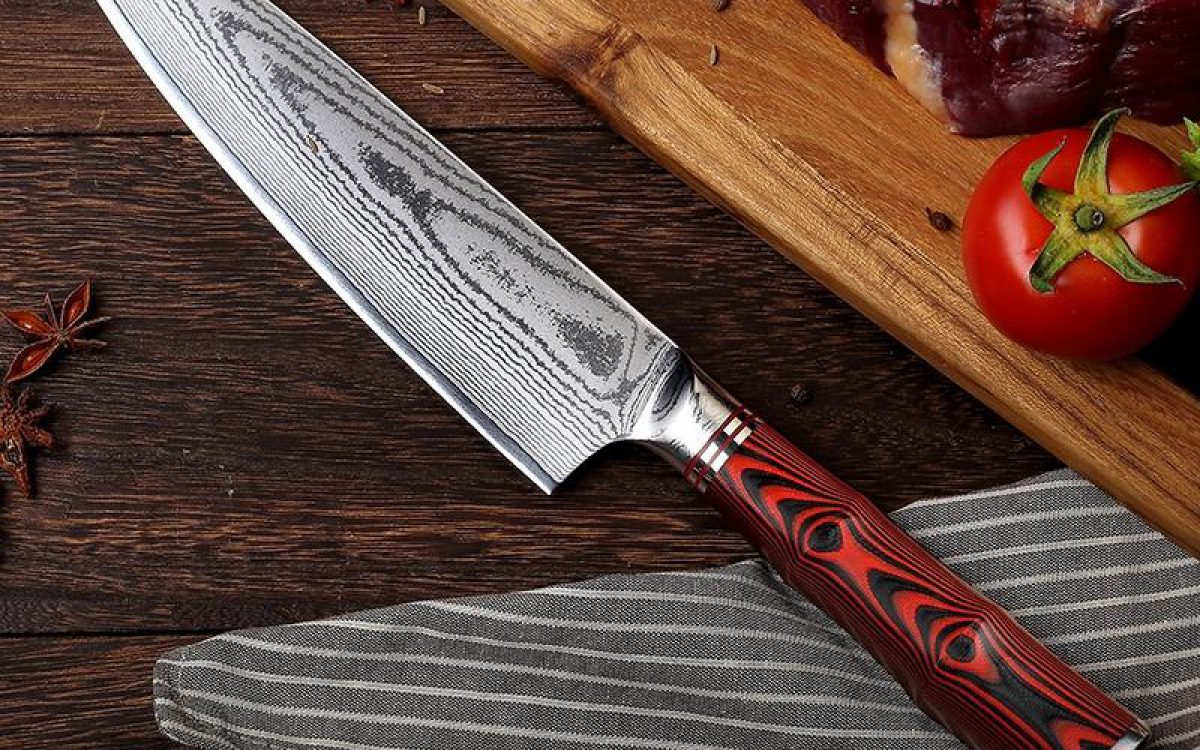
San-mai literally means three layers. A hard core steel is sandwiched between two layers of softer, more corrosion-resistant steel, and the assembly is forge-welded into a single billet before being formed into a blade. It is one of the oldest constructions in cutlery and remains one of the most useful.
This article explains what the construction does, what it cannot do, and how to tell a genuine clad blade from a decorative imitation.
Why anyone would laminate steel
A cutting blade wants two properties that pull against each other:
| Property | Wanted at | Why it conflicts |
|---|---|---|
| High hardness | The edge | Hard steel resists wear but is brittle and prone to chipping |
| High toughness | The body | Tough steel resists impact but wears quickly and cannot hold a fine edge |
| Corrosion resistance | The whole blade | Hard, high-carbon cores are generally less corrosion resistant than softer stainless |
| Easy maintenance | The whole blade | Hard cores are harder to grind and thin |
A monosteel blade has to compromise. A clad blade does not: it puts a hard core where the cutting happens and a softer, more corrosion-resistant shell everywhere else. The core is typically exposed only at the edge, forming a narrow band along the cutting bevel.
How the billet is made
| Step | What happens | Quality risk |
|---|---|---|
| Surface preparation | Core and cladding surfaces are cleaned and ground flat | Incomplete cleaning causes delamination |
| Stacking | Core between two cladding plates | Misalignment shows later as an asymmetric core |
| Tack welding or binding | The stack is fixed before heating | Movement during handling |
| Heating | To forging temperature in a controlled atmosphere or with flux | Oxidation prevents a sound bond |
| Forge welding | Pressure bonds the layers into one solid | The critical step — incomplete bonding is invisible until grinding |
| Rolling / drawing | Reducing to the required thickness | Thickness variation across the billet |
| Blade forming | Stamping, cutting or forging to profile | — |
| Heat treatment | Hardening the whole assembly | The cladding must tolerate the core's treatment without becoming brittle |
| Grinding | Exposing the core at the edge | Over-grinding removes the core; under-grinding hides it |
The heat treatment step is where clad steels demand more care than monosteel. The core may want a high austenitising temperature and a fast quench; the cladding may not respond well to either. A well-matched pair of steels is chosen so the treatment that hardens the core does not ruin the cladding.
What the construction actually buys you
| Claim | Accurate? | Explanation |
|---|---|---|
| The edge is as hard as the core steel | Yes | Provided the core is properly exposed and correctly treated |
| The blade is tougher than a monosteel blade of the same core | Generally yes | The cladding restrains crack propagation and absorbs impact |
| It is more corrosion resistant | Often yes | The flanks are cladding steel; the exposed core can still stain |
| It makes the knife cut better | Not by itself | Cutting performance is set by geometry and hardness, not by construction |
| It is stronger than a thick monosteel blade | Not necessarily | A thin clad blade is still thin; stiffness comes from thickness |
| It allows a thinner blade without loss of strength | Yes, with limits | This is one of the genuine advantages for thin, hard kitchen blades |
The pattern question
Layer-welded steel is often called Damascus, and the layered structure is what produces the visible pattern once the surface is etched — the cladding and the core respond differently to acid. There are three distinct things sold under this name:
| Type | How it is made | What it costs |
|---|---|---|
| Forge-welded layered steel | Multiple layers stacked and folded, or a three-layer billet | Genuinely expensive in labour and yield |
| Powder metallurgy patterned steel | Different powders consolidated and rolled to produce a pattern | Expensive in material, cheaper in labour |
| Laser-etched or printed pattern | Pattern applied to a monosteel blade by laser or print | Cheap; no structural difference at all |
Only the first two are layered constructions. The third is a decoration. Telling them apart is a matter of looking at the pattern's relationship to the edge, not at how striking it is — covered in real vs decorative Damascus.
How to check whether the core is real
- Look at the cutting bevel. A genuine clad blade shows a narrow band of core steel running along the edge, distinct in colour and pattern from the flanks. It should run the full length and be reasonably consistent in width.
- Compare the two sides. The core should appear symmetrically on both faces. A core visible on one side and not the other indicates a manufacturing problem.
- Check the spine. On a true three-layer billet, the spine typically shows the cladding on the outside and the core in between, in a sandwich visible at the top edge.
- Measure hardness at the edge region and at the flank. A genuine clad blade can show a difference between the exposed core and the cladding, provided the test locations are prepared and the method is capable of distinguishing them.
- Ask for the construction specification. Core grade, cladding grade and thickness ratio should all be stated. A blade described only as "Damascus" has no specification. See steel grades.
Cost and where clad construction makes sense
| Programme | Clad construction appropriate? |
|---|---|
| Budget retail, dishwasher-first | No — a single corrosion-resistant steel is cheaper and more predictable |
| Mainstream private label | Not needed |
| Mid-tier with a premium story | Yes, where the pattern and the edge story justify it |
| Premium, thin-bladed, high-hardness | Yes — this is where the construction earns its cost |
| High-volume price-driven | No |
The construction's real value is at the top of the range, where a very thin blade at high hardness would be fragile as a monosteel. Below that, the cost premium is largely a cosmetic purchase, and a well-ground single-steel blade is the better engineering choice.
FAQ
Does san-mai make a knife easier to sharpen?
The cladding is usually softer and grinds more readily, which can make thinning easier, but the edge itself is core steel and behaves exactly as that steel would in a monosteel blade. The notion that cladding makes a knife easy to sharpen is only partly true.
Can a clad blade delaminate in use?
A properly forge-welded billet will not. A poorly bonded one can, and the failure usually appears during grinding or the first heat treatment rather than in service. This is why the billet supplier matters more than the knife assembler in a clad programme.
Is a clad blade worth it for a dishwasher-heavy market?
Usually not. Cladding helps corrosion resistance, but the exposed core at the edge is still the least corrosion-resistant part, and dishwasher chemistry is aggressive. Prioritise a corrosion-resistant core if the market is dishwasher-first — see dishwasher testing.
Does the thickness ratio matter?
Yes. A thicker core means more hard steel at the edge and less cladding restraint. A very thin core can be ground away during normal sharpening. The ratio should be part of the specification, and a supplier who cannot state it is not controlling it.
Looking for a kitchen knife manufacturer?
We manufacture chef knives, knife sets, Damascus and steak knives in Yangjiang with OEM and private label service. Get a quote today.
Get Free Quote → Browse Products